
💬 The Honest Starting Point: ChatGPT ads launched on February 9, 2026, with a $60 CPM and a $200K minimum.
What they did not launch with: conversion tracking. There is no pixel. There is no attribution path. Advertisers receive aggregate impressions and clicks… and that’s it. This is not a gap that will be quietly fixed in a patch. It reflects how the platform is architecturally designed. Knowing this upfront is the most useful thing a growth marketer can understand right now.
Every major digital advertising channel we’ve relied on for the past 15 years was built around one principle: you can follow the user from impression to conversion.
A pixel fires. A click ID is passed. A GA4 event is recorded. You know what you spent and what you got. That closed loop is the foundation of performance marketing.
ChatGPT ads break that loop. Not incidentally, not as a temporary limitation, but by design. It’s a structural choice OpenAI has made to preserve user trust.
Understanding what that means for measurement, and how to work around it, is now one of the most important skills in a growth marketer’s toolkit.
What OpenAI Actually Gives You
OpenAI has been explicit in both its public announcements and its Help Center documentation about what advertisers receive. There are no ambiguities here. This is stated policy, not a gap in the docs.
Here’s a breakdown of what you can access with Open AI and what not.
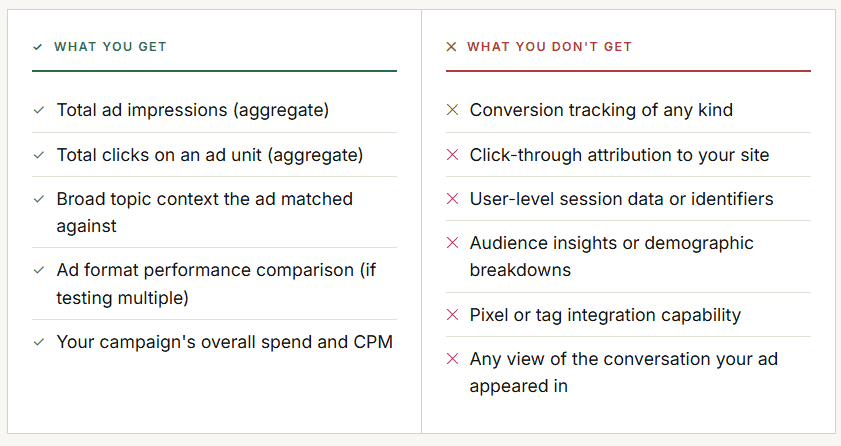
So basically, OpenAI will allow you to track total ad impressions and clicks on ad unit and give you conextual overview of where your ad appeared.
However, it doesn’t provide any conversion tracking or any click-through attribution to your website, pixel or tag integrations, nor any audience insights or demographics. So the tracking options that you have from OpenAI are pretty slim.
This is OpenAI states in its Help Center:
“Advertisers do not have access to your chats, chat history, memories, or personal details. Advertisers only receive aggregated, non-identifying information about how their ads perform, such as total views or clicks.”
This is the most significant difference between ChatGPT ads and every other major digital ad platform.
Google Ads gives you conversion paths. Meta gives you a pixel. Even newer channels like Connected TV have deterministic identity resolution in progress. ChatGPT gives you a view counter and a click counter. That’s the starting point.
Why This Gap Exists And Why It Won’t Disappear Quickly?
The measurement limitation is there on purpose. It’s load-bearing architecture.
OpenAI has made user privacy and trust the explicit foundation of its ad product. The company’s internal priority framework, as described by Ads Lead Assad Awan, ranks user trust above advertiser value and above revenue.
Giving advertisers granular tracking of user behavior inside a conversation would fundamentally undermine that foundation.
As stated in a nice article by Optimum7:
Research and decision-making often happen entirely within the ChatGPT conversation. A user might see your ad, consider it while researching, and eventually convert through a direct visit, a branded search, or an offline purchase. From a reporting standpoint, that influence is invisible.
There’s also a structural reason beyond trust: ChatGPT ads do not always trigger a click.
A user can see an ad, absorb the brand message, end the conversation, and convert later through a direct visit, a Google search for your brand name, or an offline purchase. The influence happened entirely inside the chat, without a clickable event that any downstream system can capture.
Search Engine Journal put this plainly: the $60 CPM and minimal data means “ChatGPT ads should be categorized as a brand awareness play rather than a performance channel, at least initially.
Brands should be prepared to treat it like early-stage display or OTT advertising. You’re paying for attention and reach, not ROI.”
What ChatGPT Metrics You Can Currently Track?
“Can’t measure anything” is too defeatist.
There are meaningful metrics available; you just need to reframe what “measurement” means for this channel, and build a layer of downstream tracking to compensate for what the platform won’t tell you.
| Metric | Available? | Source | Notes |
|---|---|---|---|
| Total Impressions | ✓ Yes | OpenAI reporting | Aggregate, not tied to individual users |
| Total Clicks | ✓ Yes | OpenAI reporting | Aggregate only — no session data attached |
| Click-Through Rate (CTR) | ✓ Calculated | Derived from clicks ÷ impressions | Useful for creative testing |
| Site sessions from ChatGPT | ✓ Via UTMs | GA4 + UTM parameters on your landing URL | Requires you to set this up — not automatic |
| Conversions from ChatGPT | ⚠ Partial | GA4 / CRM — only if user clicked through | Misses view-through and post-chat conversions |
| Direct traffic lift | ⚠ Inferred | GA4 Direct channel, time-period comparison | Correlation, not attribution |
| Branded search lift | ⚠ Inferred | Google Search Console, brand keyword volume | Strong downstream signal if brand is clearly shown |
| Conversion tracking | ✕ No | Not available from OpenAI | No pixel, no tag, no identity resolution |
| Audience insights | ✕ No | Not available from OpenAI | No demo, behavioral, or interest breakdown |
The Workarounds To Measure ChatGPT Ads
The good news is that performance marketers have faced measurement constraints before.
Connected TV, podcast advertising, and out-of-home, and built rigorous frameworks around them. The same methodologies apply here.
Here are the five approaches being deployed by pilot advertisers and agency teams right now.
Step One: UTM Parameters on Every Landing URL
The single most important immediate step.
When you submit your ad creative and landing URL to OpenAI, tag that URL with a full UTM string. This lets GA4 identify sessions that originated from your ChatGPT ad click — at minimum capturing the users who did click through.
It won’t capture view-through traffic, but it closes the loop on direct clicks. Set a naming convention now and don’t deviate from it.
?utm_source=chatgpt&utm_medium=cpc&utm_campaign=brand-q1&utm_content=sponsored-response
Step Two: Monitor Direct Traffic and Branded Search as Downstream Signals
ChatGPT ads show your brand name prominently to users in a high-attention context.
Even without a click, users who see your ad may later visit your site directly or search for your brand on Google. Establish weekly baselines for both Direct channel traffic in GA4 and branded search volume in Google Search Console before your campaign goes live.
Compare against those baselines during and after the campaign window.
A sustained lift in either is a strong signal of incremental brand exposure. I’s not perfect attribution, but it’s defensible evidence.
Step Three: Pre-Register an Incrementality Test
Before you spend a dollar, write down in advance what metric must move, by how much, relative to what baseline, and in what time window for the campaign to be considered successful.
This is called pre-registration and it’s critical for ChatGPT ads because, without it, it’s easy to retrofit a success definition to whatever the first report shows.
AdSkate’s measurement playbook is explicit on this: “Pre-register an incrementality approach so results are not confused with demand already captured by existing search and social.”
A geo holdout test — running ads in some markets and not others — is the cleanest implementation.
Step Four: Run a Brand Lift Study Alongside Your Campaign
Brand lift studies measure awareness, recall, purchase intent, and brand perception through surveys.
Comparing users who were exposed to your ad against a matched control group who wasn’t.
For a channel where conversions are hard to track, brand lift is the most credible measurement of whether the $60 CPM is doing anything. P
latforms like Lucid, Dynata, or Kantar can run these independently of OpenAI’s reporting. Budget for this from day one of any pilot.
Step Five: Check Your CRM for “ChatGPT-Influenced” Paths
If a user clicks through to your site via a UTM-tagged URL, that session can be tracked.
But even without a direct click, you can look for patterns in your CRM: did the number of new leads who mention ChatGPT in a form field or survey increase during the campaign period?
Did customer acquisition in the verticals you targeted in ChatGPT show an uptick?
These are soft signals, but they build a fuller picture alongside your direct GA4 data.
New KPIs ChatGPT Ads Actually Demand
A part of the measurement problem is using the wrong scorecard. Applying a Google Ads ROAS framework to a channel that doesn’t support conversion tracking will always produce disappointing results.
Several industry practitioners are proposing new KPI categories better suited to the conversational context:
- Conversational Engagement Rate: The percentage of ad impressions that prompt a user to ask a follow-up question about the advertised product (enabled by ChatGPT’s “Ask ChatGPT” ad feature). Higher than a standard CTR because it captures intent to learn more, not just intent to click.
- Share of Assistant Visibility: How frequently your brand appears — organically and via paid — when ChatGPT answers queries in your category. Tracks paid exposure alongside organic AI citation as one unified metric. Analogous to Share of Voice in traditional media.
- Downstream Brand Search Lift: The percentage increase in branded search queries on Google, measured against a pre-campaign baseline, during and after a ChatGPT ad campaign. A proven proxy metric for TV and CTV advertising — and highly relevant here.
- Direct Traffic Uplift Rate: The percentage increase in Direct channel sessions in GA4 during a campaign window vs. baseline. Less clean than branded search lift, but captures users who remembered your brand and came back without a search. Best measured in weekly cohorts.
A promising data point: Research analyzing 12 million website visits found that traffic originating from AI platforms (ChatGPT, Claude, Perplexity) converts at 14.2% — compared to 2.8% for Google traffic. That’s a 5x conversion rate differential.
Our theory: AI-referred visitors have done more research, have higher intent, and arrive closer to a purchase decision. But the measurement limitations make it hard to prove this directly at the campaign level.
It’s the best argument for investing in UTM hygiene and downstream CRM tracking immediately.
What’s Coming? OpenAI’s Measurement Roadmap
OpenAI is not treating this as the finished state.
In September 2025, the company posted a job listing for a “Growth Paid Marketing Platform Engineer” specifically tasked with building real-time attribution pipelines, integrating with major ad platforms, and developing experimentation frameworks. That talent hire is a signal that measurement sophistication is on the roadmap, just not built yet.
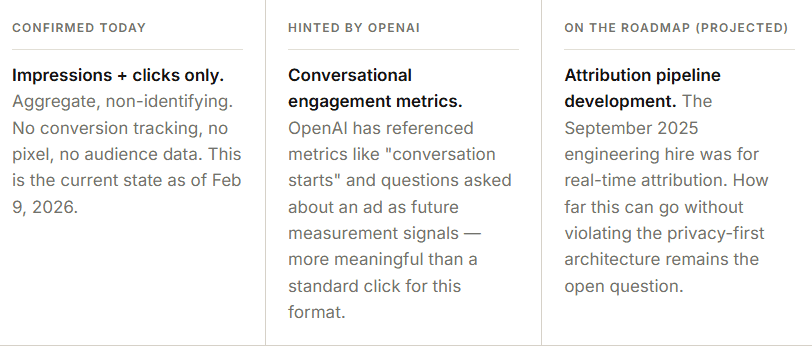
The key constraint is structural, not just technical: OpenAI has drawn a firm line between the ad system and the user’s conversation data.
Advertisers will never see what was said. The question is how much aggregate and anonymized conversion signal can be inferred and fed back without crossing that line. OpenAI’s measurement roadmap likely looks less like Meta’s pixel and more like Apple’s SKAdNetwork — aggregate, privacy-preserving, probabilistic.
The ChatGPT Ads Measurement Playbook
You can wait for OpenAI to launch more measurement tools, or you can start measuring right now by following these steps:
- Accept the baseline: you have impressions and clicks. That’s the official data. Build from there, not from what you wish existed.
- UTM-tag every landing URL before submitting creatives. This is non-negotiable and costs nothing. Without it, you can’t even see the traffic that does click through.
- Establish pre-campaign baselines for direct traffic and branded search volume. These are your downstream attribution proxies for the view-through influence you can’t directly track.
- Pre-register your incrementality definition in writing before the campaign starts. What metric, what lift, what time window counts as success. This prevents retrofitted narratives later.
- Commission a brand lift study alongside any significant spend. For a brand awareness channel, it’s the most credible measurement available.
- Reframe the scorecard: this channel is brand awareness and high-intent reach today, not performance attribution. Price your expectations accordingly, and benchmark against CTV and podcast — not Google Search.
- Watch OpenAI’s engineering announcements. The real-time attribution pipeline is being built. When it ships, teams with clean data infrastructure will be able to use it immediately.
That’s it!
You can also reach out to us and help us set up all this for you and get you ready for the AI-powered advertising future. We are a ChatGPT advertising agency, too. Good luck!


0 Comments