
TL;DR
- A 7-email post-purchase sequence covers the gap between checkout and the next purchase decision.
- Split the flow by first-time vs. repeat buyer — the messaging needs are completely different.
- Send 2 emails before delivery, 3 after delivery, and 2 in the replenishment window.
- Layer SMS into delivery and review steps to lift sequence revenue 28-35%.
What is a post-purchase email flow?
A post-purchase email flow is an automated sequence triggered the moment a customer places an order. It typically includes 5-8 emails covering order confirmation, shipping updates, thank-you, education, review request, and cross-sell. The goal is to drive a second purchase within 60 days.
How many emails should be in a post-purchase flow?
Most DTC brands should run 5-8 emails over 30-45 days. Fewer than 5 leaves revenue on the table; more than 8 starts hurting deliverability. We recommend 7: 2 transactional, 1 thank-you, 1 educational, 1 review request, and 2 cross-sell or replenishment.
How long should a post-purchase email flow run?
A complete post-purchase flow runs 30-60 days. The first 14 days handle delivery and onboarding, days 15-30 cover reviews and cross-sells, and days 30-60 trigger replenishment for consumables or a second-purchase nudge for non-consumables.
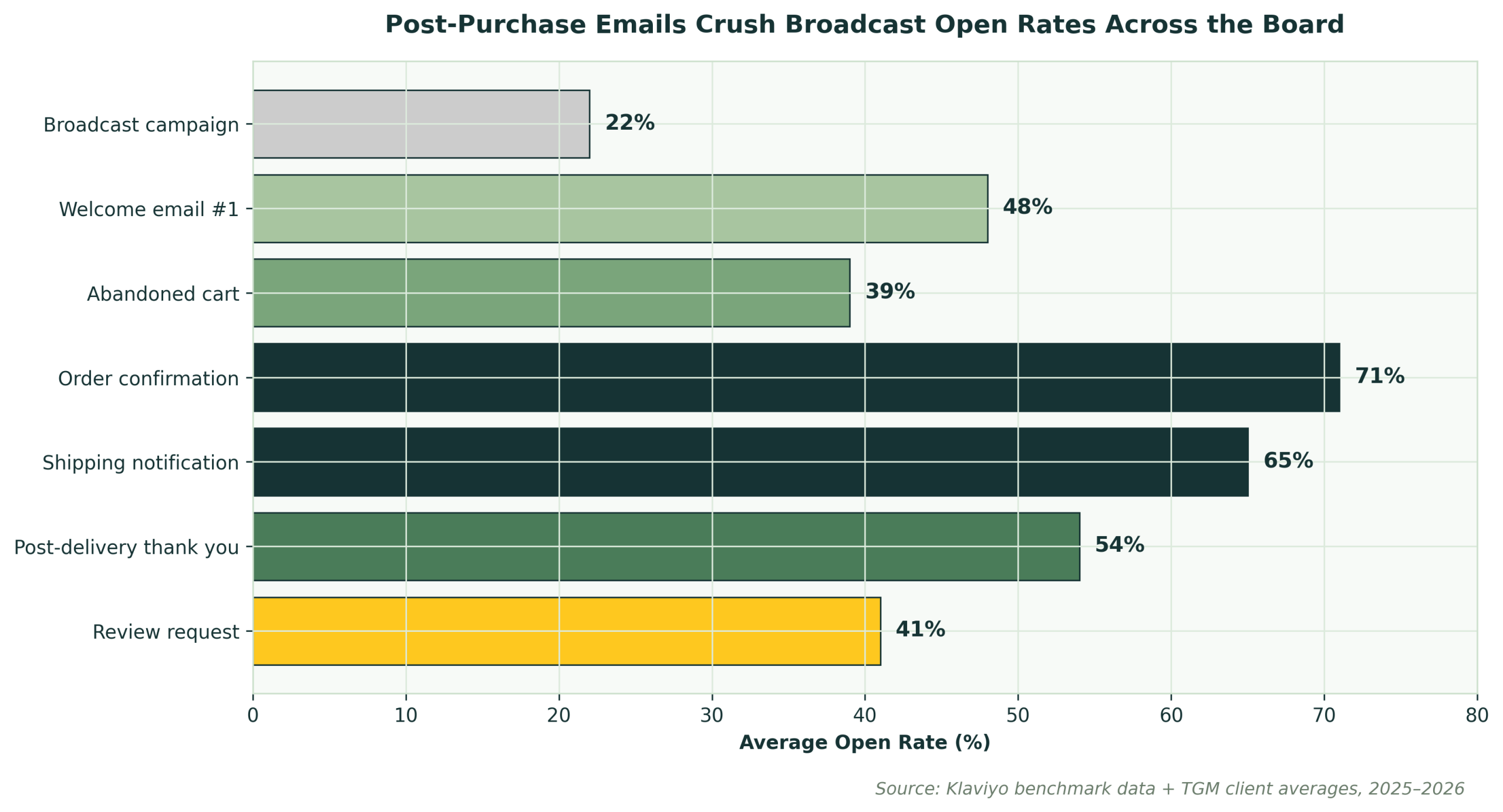
The first 30 days after a purchase are the most profitable window in DTC. Yet most brands treat post-purchase like a glorified shipping receipt — a single confirmation email, maybe a tracking update, then radio silence until the next promo blast. That neglect is expensive. According to Klaviyo's benchmark research, post-purchase messages see 217% higher open rates and 90% higher revenue per recipient than standard broadcast campaigns.
This guide is the build-spec we use with our Klaviyo agency clients to turn first-time buyers into 90-day repeat customers. It covers the 7-email sequence that drives 18-24% of total email revenue for the brands we manage, the segmentation logic that prevents you from cross-selling someone before their order has shipped, and the specific Klaviyo trigger filters that keep the flow clean as you scale.
Why Post-Purchase Is the Most Profitable Flow in DTC
Most DTC brands obsess over abandoned cart and welcome flows because they can attribute revenue to them quickly. Post-purchase rarely gets the same scrutiny — but it should. The customer has already paid you, trusts you enough to share their email and address, and is in the highest-engagement window of their relationship with your brand.
"Post-purchase messages drive 217% higher open rates and 90% higher revenue per recipient than your average email campaign." — Klaviyo Benchmark Report, 2025
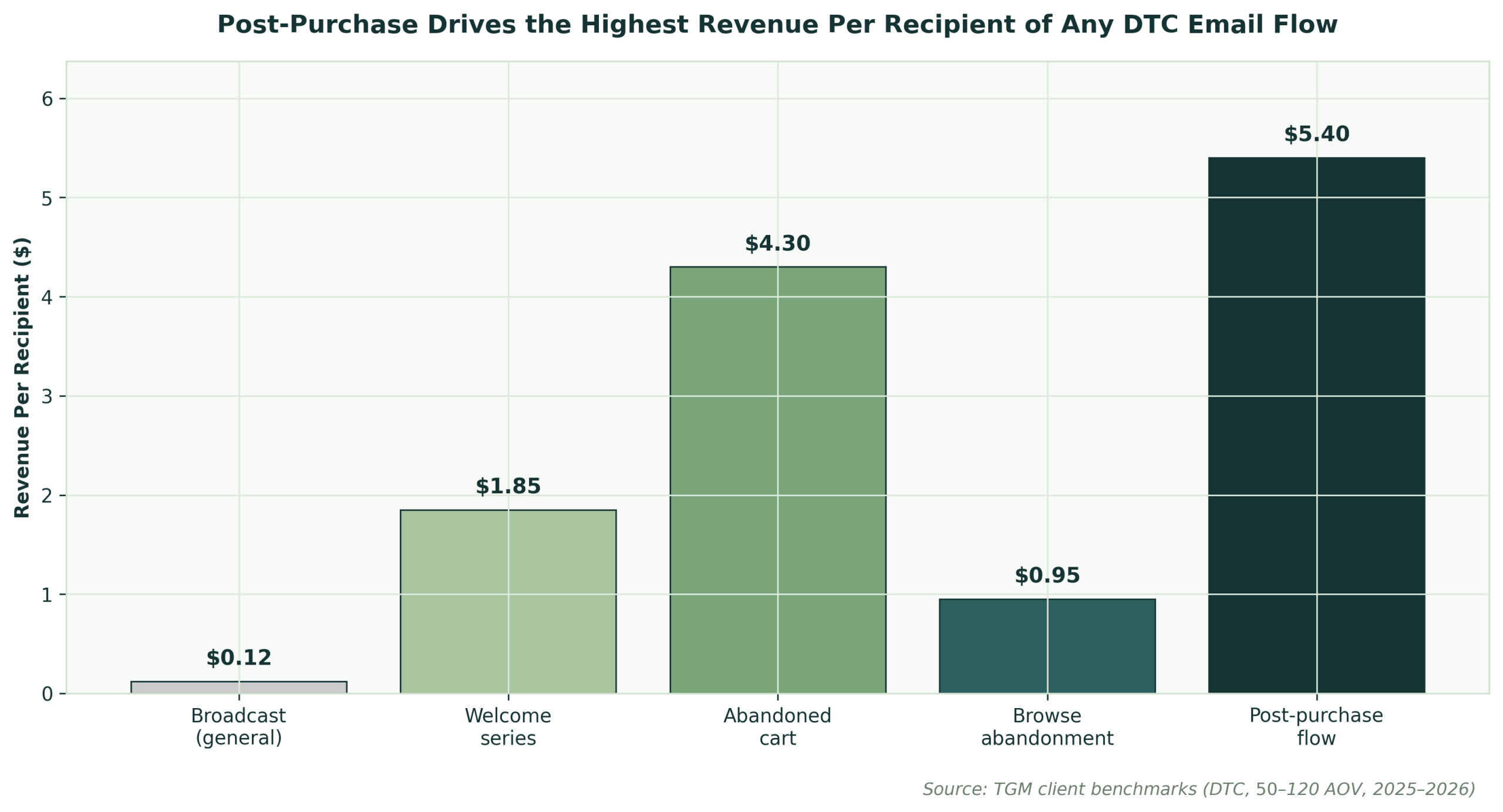
The math is brutal for brands that skip it. If your customer acquisition cost is $42 and your average order value is $58, you need a second order to make the first profitable. Without a deliberate post-purchase flow, you're praying the customer remembers you in 60 days — when they'll get re-acquired through a paid ad you'll pay for again. The flow is your defense against re-paying for customers you already own.
The 7-Email Sequence That Drives 18-24% of Email Revenue
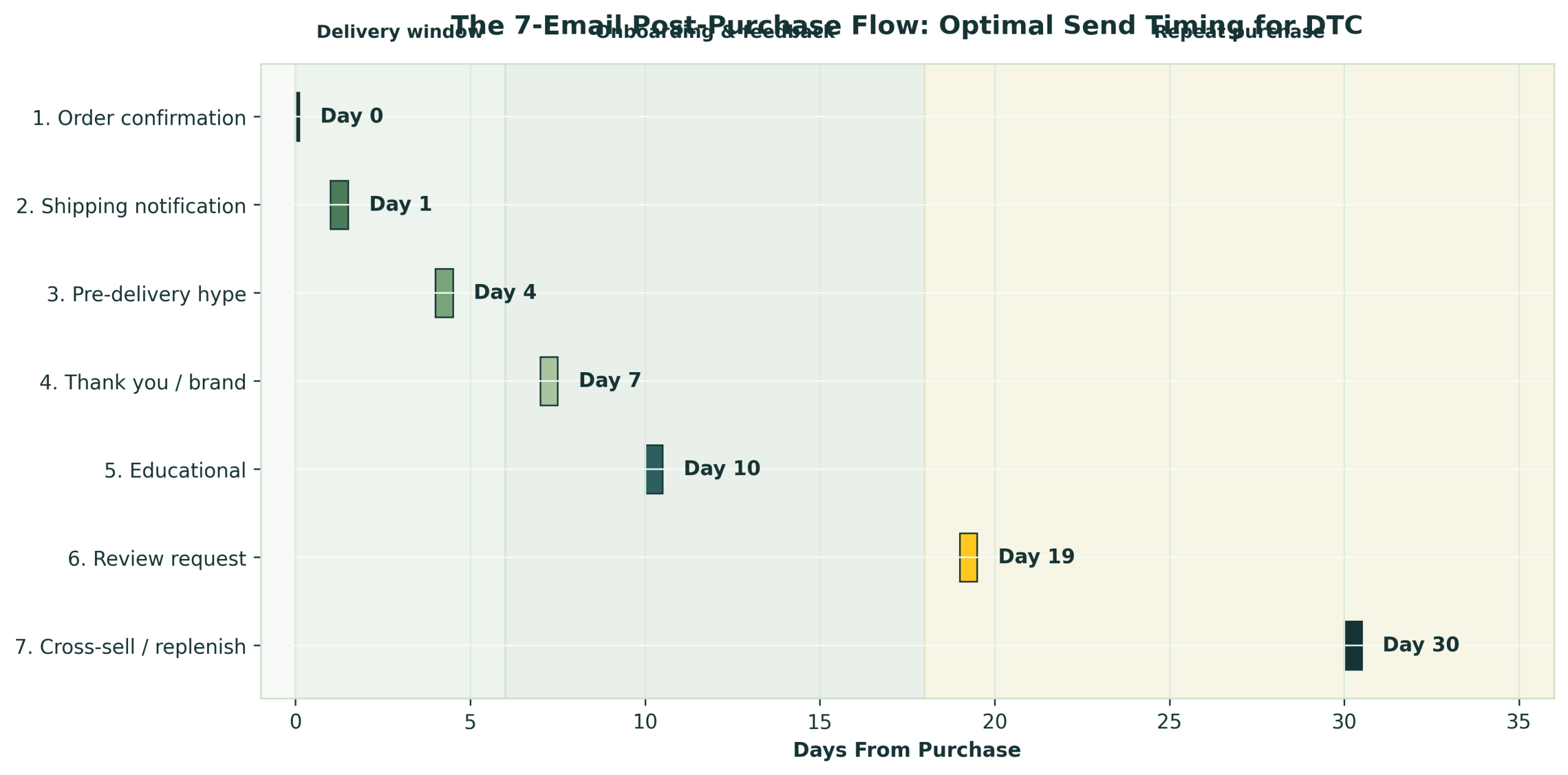
A complete post-purchase flow covers four jobs: confirm, build relationship, extract feedback, and drive the second purchase. Here is the sequence we deploy by default:
- Order confirmation — instant trigger; transactional but on-brand.
- Shipping notification — fires on tracking number creation; include a soft "while you wait" content link.
- Pre-delivery hype — sent 1 day before estimated delivery; sets expectations and primes excitement.
- Thank you / brand story — sent 2 days after delivery; no offer, just connection.
- Educational how-to — sent 5 days after delivery; product usage tips, FAQs, or a video walkthrough.
- Review request — sent 14 days after delivery via Klaviyo Reviews or your reviews app integration.
- Cross-sell or replenishment — sent 30 days after delivery for non-consumables; based on average product lifecycle for consumables.
Each email should sit on its own delay timer and use Flow Filter logic so a customer who places a second order mid-flow doesn't keep getting "Hope you love your purchase!" messages for an order that's now stale.
Klaviyo Trigger Logic That Prevents Flow Chaos
The biggest mistake we see in audits is a post-purchase flow with no exit conditions. A customer places an order, enters the flow, then orders again on day 8 — and Klaviyo keeps drip-feeding them emails about an order they already received. Always set the following filters at the flow level:
- Has placed an order zero times since starting this flow — exits the customer if they purchase again, so the second order can trigger its own (cleaner) version of the sequence.
- Has not unsubscribed from email — obvious, but worth verifying.
- Profile properties match expected purchase channel — if you sell on Shopify and Amazon, segment so Amazon orders don't trigger a Shopify-branded flow.
For multi-product catalogs, use Conditional Splits at email 4 and beyond to branch based on the variant or collection purchased. A customer who bought a starter kit needs a different educational email than one who bought a refill — same flow, different content. Klaviyo's flow filter documentation covers the syntax, but the principle is: every send must answer "is this still relevant given everything I now know about this customer?"
Segmentation: First-Time vs. Repeat Buyer Paths
A first-time buyer needs to be welcomed into your brand world. A repeat buyer needs to feel recognized, not re-onboarded. Treating them identically is the single fastest way to torch repeat-customer engagement.
Build a Conditional Split at the very top of the flow checking Number of Orders is 1. The first-time path runs the full 7-email sequence with brand-story content, education, and a soft cross-sell. The repeat path skips the brand introduction entirely, opens with "Glad you're back," and jumps faster to the cross-sell or replenishment ask.
"VIP customers should never get the same welcome-style content as a first-time buyer. Recognize them or risk training them to ignore your emails." — TGM client audit, 2026
For brands with subscription products, add a third path that funnels into the subscription upgrade ask after delivery confirmation. If you want a deeper look at flow architecture across the whole lifecycle, our Klaviyo Flow Checklist tool breaks down all 15 essential flows and where post-purchase fits.
Timing Windows: When Each Email Lands
Timing is where most DTC brands quietly lose 10-15% of potential sequence revenue. Send the educational email before the order arrives and it's irrelevant. Send the review request before the customer has formed an opinion and you'll get short, neutral reviews that hurt your social proof.
Use these windows as defaults and tune from there:
- Order confirmation: Immediate (0 minutes).
- Shipping email: Trigger on
Fulfilledevent, not on a timer. - Pre-delivery hype: 24 hours before Shopify's estimated delivery date.
- Thank-you: 48 hours after
Deliveredevent. - Educational: 5 days after delivery.
- Review request: 14 days after delivery (consumables) or 21 days (durables).
- Cross-sell: 30 days after delivery for non-consumables; for consumables, base it on product run-rate (a 30-day supply triggers at day 22-25).
Adding SMS to Amplify Revenue
Email handles the long-form work. SMS handles urgency and high-conversion moments. Adding SMS to the post-purchase flow at two specific points — delivery confirmation and the review request — typically lifts total sequence revenue 28-35% in our internal book.
The rule: SMS only fires on customers with explicit SMS consent, never as a duplicate of the email. Use SMS for the moments where immediacy beats depth: "Your order arrived today, here's a 2-min unboxing video" or "Quick favor — 30 seconds for a star rating?" Klaviyo's combined email+SMS flows let you condition each step on consent so non-SMS subscribers still get the email path. Brands new to SMS should start with these two touchpoints before expanding — see Klaviyo's SMS deliverability guide for opt-in compliance specifics.
"Spam complaints fell about 74% on a premium fashion brand's email program." — Top Growth Marketing
Measuring Success: The 5 Metrics That Matter
Skip the vanity metrics. The five numbers that tell you whether your post-purchase flow is working are:
- Revenue per recipient (RPR) at flow level — should be $4-$8 across the full sequence for a brand with $50-$80 AOV.
- Click-through rate by email — anything below 2% on emails 4-7 means content is generic.
- 60-day repeat purchase rate for customers who entered the flow vs. control — minimum 12% lift, target 20%+.
- Review submission rate — healthy is 4-8% of recipients leaving a review.
- Unsubscribe rate per email — flag anything over 0.4% on a single send. Our full breakdown of flow-level KPIs lives in our email marketing KPIs guide.
Pull these into a single Klaviyo dashboard and review monthly. Anything trending the wrong way for two months running gets a copy refresh, a timing tweak, or a segmentation rebuild — in that order.
Frequently Asked Questions
How is a post-purchase flow different from a welcome flow?
A welcome flow targets subscribers who haven't bought yet — its job is to convert. A post-purchase flow targets paying customers and its job is to drive a second purchase, build loyalty, and extract reviews. They should never overlap, and a customer entering a post-purchase flow should be exited from the welcome flow automatically.
Should I send the same post-purchase emails to first-time and repeat buyers?
No. Use a Conditional Split at the top of the flow on `Number of Orders` and run two separate paths. First-time buyers need brand context and education; repeat buyers need recognition and a faster cross-sell. Sending repeat buyers a "welcome to the brand" email is the fastest way to train them to ignore you.
When should the cross-sell email fire?
For non-consumables, fire it 30 days after the `Delivered` event. For consumables, base it on average product lifecycle — a 30-day supply triggers at day 22-25, a 60-day supply at day 50-55. Pulling this from your average reorder data gives a 2-3x lift over a fixed delay.
How do I avoid sending post-purchase emails to someone who has already reordered?
Set the flow filter to `Has placed an order zero times since starting this flow`. This exits any customer who places a new order mid-sequence. Their second order then triggers a fresh, clean instance of the flow — eliminating the "still raving about your last order" awkwardness.
What's a realistic revenue contribution from a post-purchase flow?
For DTC brands with a working flow, post-purchase typically drives 18-24% of total email revenue, with welcome and abandoned cart making up another 35-45%. If your post-purchase contribution is under 10%, the flow is either too short, missing segmentation, or has no cross-sell at the back end.
Last updated:












0 Comments