
Revenue is vanity and margin is sanity. We often double down on that saying when speaking to clients.
TL;DR
- Average eCommerce net margin is ~10% — most DTC brands run thin once ad spend, returns, and shipping are fully loaded.
- Gross margin and net margin are not interchangeable: gross margin ignores CAC, shipping subsidies, platform fees, and overhead.
- Profit margin benchmarks vary sharply by vertical — supplements often hit 20–30%, while fashion and electronics run closer to 5–10%.
- The fastest margin wins come from reducing return rates, negotiating COGS, and tightening cost-per-order efficiency before scaling spend.
What is a good profit margin for an eCommerce business?
A good net profit margin for eCommerce is typically 10–20%, though this varies by vertical. The industry average net margin sits around 10%, while gross margins usually range from 40–60% depending on product category. Brands below 10% net margin should prioritize cost structure before scaling ad spend.
What's the difference between gross margin and net margin in eCommerce?
Gross margin subtracts only the cost of goods sold (COGS) from revenue. Net margin subtracts every cost — including ad spend, shipping, fulfillment, payment processing, returns, and overhead. Most Shopify dashboards default to gross margin, which can look much healthier than your actual take-home profitability.
How can eCommerce brands improve their profit margin?
The highest-impact margin levers are: reducing your return rate (each 1% drop adds meaningful net margin), renegotiating COGS with suppliers at volume, improving CAC efficiency through better creative and targeting, and reducing shipping costs through 3PL negotiations or zone-skipping. Subscription models and loyalty programs also increase margin by reducing re-acquisition costs.
Yet, we still see a shocking number of brands that optimize for vanity. But the average eCommerce business runs at roughly 10% net margin.
On a $100 order, that's $10 in real profit, that's before you account for discounts, customer service time, or the occasional warehouse problem. And that's the average. Brands without a clear view of their margins often discover they're below it.
The good news: profit margin is one of the most fixable metrics in eCommerce. But you have to know what you're measuring, what "good" actually looks like for your category, and where the most common leaks are hiding.
Gross Margin vs. Net Margin: Two Different Numbers
Most eCommerce dashboards show you gross margin by default. Shopify, Amazon Seller Central, and most accounting templates all lead with it. Here's the problem: gross margin is only half the story.
Gross Margin = (Revenue − COGS) ÷ Revenue × 100
This tells you how much revenue is left after subtracting the cost to produce or source your product. It doesn't include shipping, fulfillment, ad spend, platform fees, returns, or any fixed overhead.
Net Margin = (Revenue − All Costs) ÷ Revenue × 100
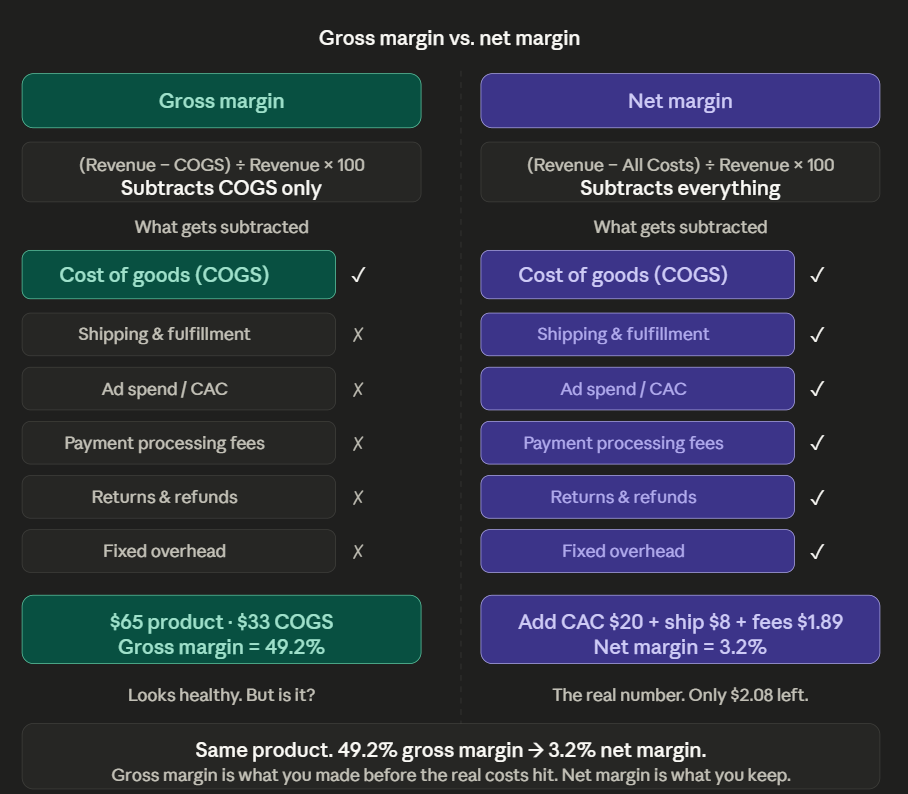
This is the number that actually matters. It's what you keep after every cost has been paid — including the ones that don't show up in your COGS.
A product with a 60% gross margin sounds healthy. Add a $20 CAC, $8 shipping subsidy, and 2.9% in payment fees to a $65 selling price, and your net margin shrinks fast. Many founders are shocked the first time they run the full calculation.
💡 TIP: Most eCommerce platforms show gross margin by default, and this creates a dangerous illusion of profitability. Always calculate your fully-loaded margin before making scaling decisions.
What's a Good Profit Margin for eCommerce? The Benchmarks
There's no single answer, but there are meaningful benchmarks. Here's what to target at each level:
| Margin Type | Benchmark | What It Signals |
|---|---|---|
| Gross margin | 50%+ | Enough room to absorb variable costs, returns, and ad spend |
| Net margin | 15%+ | Healthy DTC — allows for reinvestment and sustainable scaling |
| Net margin | 20%+ | Strong — room to acquire customers aggressively and still build cash |
| Net margin | Below 5% | Fragile — one bad month or CAC spike can push you negative |
The average gross margin across all eCommerce sits around 45%. The average net margin is closer to 10%. But averages include a lot of brands that are one rough quarter from closing. Don't benchmark yourself against the middle — benchmark against what sustainable growth actually requires.
Profit Margin Benchmarks by Vertical
Category matters enormously here. A 25% net margin is exceptional for electronics and uncomfortable for beauty.
Here's what we at Top Growth Marketing see across our portfolio of 200+ DTC partnereship brands:
| Vertical | Typical Gross Margin | Target Net Margin |
|---|---|---|
| Beauty & Health | 67–83% | 20–30% |
| Supplements | 65–80% | 18–28% |
| Apparel | 50–67% | 12–20% |
| Food & Beverage | 43–60% | 8–15% |
| Electronics | 33–50% | 5–12% |
| Subscription | 75%+ | 25–40% |
Subscription brands consistently lead because repeat purchases generate revenue without additional CAC. Every reorder from an existing customer is essentially margin-pure, which is why smart DTC brands work so hard to build subscription cohorts and retention programs early.
Below 100% markup (roughly 50% gross margin), running profitable paid acquisition becomes genuinely difficult. At that level, your ad spend has very little room to work before it erases your margin entirely. If those two numbers sound interchangeable, they are not — a 100% markup is only a 50% margin. See markup vs margin for the full breakdown, or run your own numbers in the free markup calculator.
The Fully-Loaded Margin Calculation
Here's the math that actually matters. Walk through this for your own store:
Start with your selling price. Say it's $65.
Subtract COGS. Manufacturing, packaging, inbound freight — your true landed cost. Let's say $20.
Subtract fulfillment costs. Outbound shipping, pick-and-pack, packaging materials. Call it $7.
Subtract payment processing. At Shopify's standard 2.9% + $0.30 on a $65 order: approximately $2.19.
Subtract your blended CAC. This is your total ad spend divided by total orders — across every paid channel. Let's say $15.
That leaves: $65 − $20 − $7 − $2.19 − $15 = $20.81
Net margin: 32%. That's a healthy DTC business.
Now change the CAC to $25. Net margin drops to 15.7%. Profitable, but thinner. Change it to $35 and you're at 1.2% — essentially break-even. This is why knowing your exact cost per acquisition matters as much as your ROAS. You can't manage margin without it.
💸 Calculate your margins now: TGM's free Profit Margin Calculator walks through gross margin, net margin, and markup with built-in eCommerce benchmarks — no signup required.
The Hidden Margin Killers Most Brands Overlook
Getting your margin math right means accounting for the costs that don't show up in your COGS line.
Free shipping thresholds. If you offer free shipping over $50 and your average order value is $58, you're subsidizing shipping on most orders. That subsidy has to come from somewhere — and it usually comes from margin.
Return rates. In apparel, return rates of 20–30% are normal. If you're not baking your average refund rate into your margin calculation, you're overstating profitability on every unit.
Discounts and promotions. A 20%-off sale doesn't just reduce revenue — it compresses margin at the same cost structure. If your baseline margin is 15%, a 20% discount makes you unprofitable on that order.
Platform and marketplace fees. Amazon's referral fee alone is 15% of the selling price, plus FBA fees on top. Brands that sell across Shopify and Amazon often have materially different effective margins by channel without realizing it.
Ad attribution gaps. Platform-reported ROAS routinely overstates performance by 30–100% due to cross-channel attribution overlap. Brands scaling on platform ROAS instead of blended Marketing Efficiency Ratio often find their real margins are significantly worse than the dashboard suggests. Our ROAS guide covers how to set a target that actually accounts for your margin structure.
How to Improve Your Profit Margin
There are four levers. Most brands only pull one or two.
1. Raise prices — selectively. Most DTC brands have 5–15% unused pricing power. A small price increase on hero SKUs, combined with premium positioning or a bundle, often goes unnoticed by customers and can move net margin by several points. Test it before dismissing it.
2. Negotiate COGS. Volume contracts, alternative suppliers, or renegotiated freight rates on inbound shipments can meaningfully reduce your landed cost. Every dollar saved on COGS goes directly to contribution margin.
3. Lower your CAC. Better creative performance, tighter audience targeting, and stronger post-click conversion all reduce what you pay to acquire a customer. For brands spending heavily on paid social, even a 10% reduction in CAC can add several margin points. Our Facebook Ads team optimizes specifically for this.
4. Improve retention. Every repeat purchase from an existing customer comes with zero or near-zero CAC. Email flows, SMS, loyalty programs, and subscription models all drive repeat revenue at margins that are dramatically higher than first-order sales. This is the most durable margin expansion lever available to any DTC brand.
Most brands that come to us with margin problems are underinvesting in retention, not overspending on acquisition. Improving email flows and post-purchase sequences typically has a faster margin payback than any media optimization we can do. - Jack Paxton, Top Growth Marketing CEO
The Profit Margin Calculation You Should Be Running Monthly
Set this up as a standing monthly review. Pull your actual numbers — not platform estimates — from Shopify, your 3PL, and your ad accounts:
- Total net revenue
- Total COGS (including freight and duties)
- Total fulfillment and shipping costs
- Total ad spend across all channels
- Payment processing fees
- Returns and refund costs
- Fixed costs (team, software, rent)
Run items 2–6 against revenue for your contribution margin. Run all seven against revenue for your net margin. Do it every month. The trends will tell you more than any single number.
💸 Also useful: TGM's free Break-Even Calculator shows exactly how many units you need to sell at your current margins to cover fixed costs — so you know what "minimum viable month" looks like before you hit it.
Mind the Margins
Margin isn't glamorous. It doesn't show up in screenshots or make for viral content. But every DTC brand that builds something durable — something that scales without breaking — is obsessive about it.
Frequently Asked Questions
What is the average profit margin for an eCommerce business?
The average net profit margin for eCommerce businesses is approximately 10%, though this varies significantly by category. High-margin categories like digital products, supplements, and beauty can achieve 20–30% net margins. Lower-margin categories like consumer electronics, fast fashion, and commodities often run below 5% net. Gross margins typically range from 40–60% across most categories.
What's the difference between gross margin and net margin in eCommerce?
Gross margin only subtracts your cost of goods sold — manufacturing, materials, and inbound freight. Net margin subtracts every expense, including customer acquisition cost, shipping, fulfillment, payment processing fees, returns, SaaS tools, and team costs. Most brands are surprised at how wide the gap is between gross and net margin once all costs are loaded.
How do returns affect eCommerce profit margins?
Returns are one of the most significant margin killers in eCommerce, particularly for fashion, footwear, and electronics. A 20% return rate with a $15 average return processing cost can reduce net margin by 3–5 percentage points. Reducing return rates by improving product photography, sizing guides, and product descriptions often delivers faster margin improvement than any other single lever.
What profit margin should I target before scaling paid ads?
You should have a minimum 15–20% gross margin before scaling paid acquisition, with a clearly understood contribution margin per order (revenue minus variable costs including CAC). If your first-order economics are negative or breakeven, scaling spend will accelerate losses. Know your payback period — the time to recover CAC through repeat purchases — before increasing ad budgets.
Which eCommerce verticals have the highest profit margins?
Digital products, online courses, and SaaS have the highest margins (50–80%+ net) since there's minimal COGS. Among physical goods, health and beauty, supplements, and premium home goods typically achieve 20–35% gross margins. Apparel and fashion run 40–60% gross margins but often compress to 5–15% net after returns and markdowns. Consumer electronics is notoriously thin, often below 10% gross.
Know your gross margin. Know your net margin. Know the gap between them and exactly what's living in it. That's where your business actually is.
If you want a set of expert eyes on your margin structure and a clear plan for improving it, let's talk.
















0 Comments