
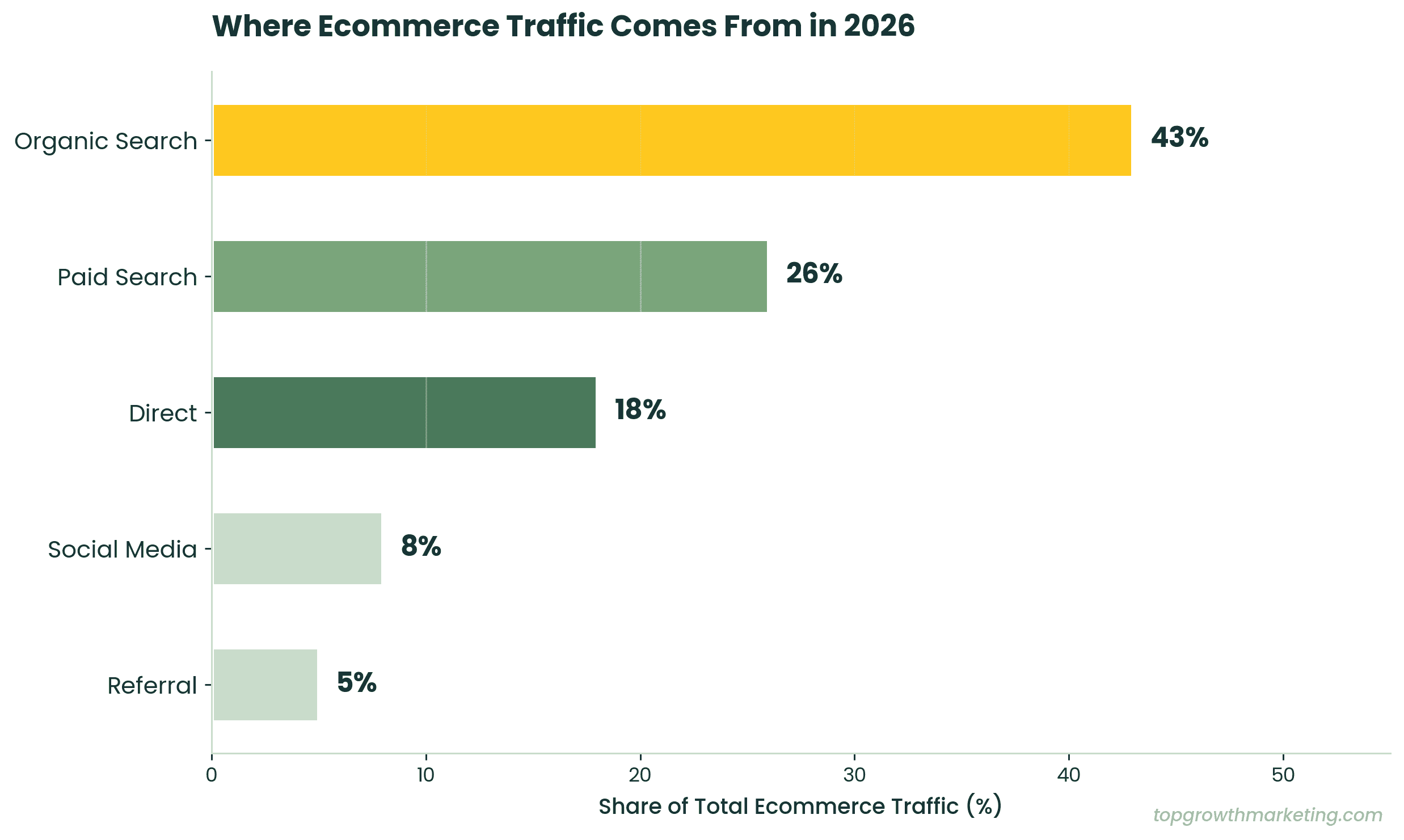
Organic search drives 43% of all ecommerce traffic and delivers a 317% ROI with a 9-month break-even, according to recent industry data. Yet most Shopify store owners treat SEO as an afterthought, burying themselves in app installs and paid ads while leaving free, high-intent traffic on the table.
TL;DR
- Organic search drives 43% of ecommerce traffic with a 317% ROI — yet most Shopify owners under-invest in SEO.
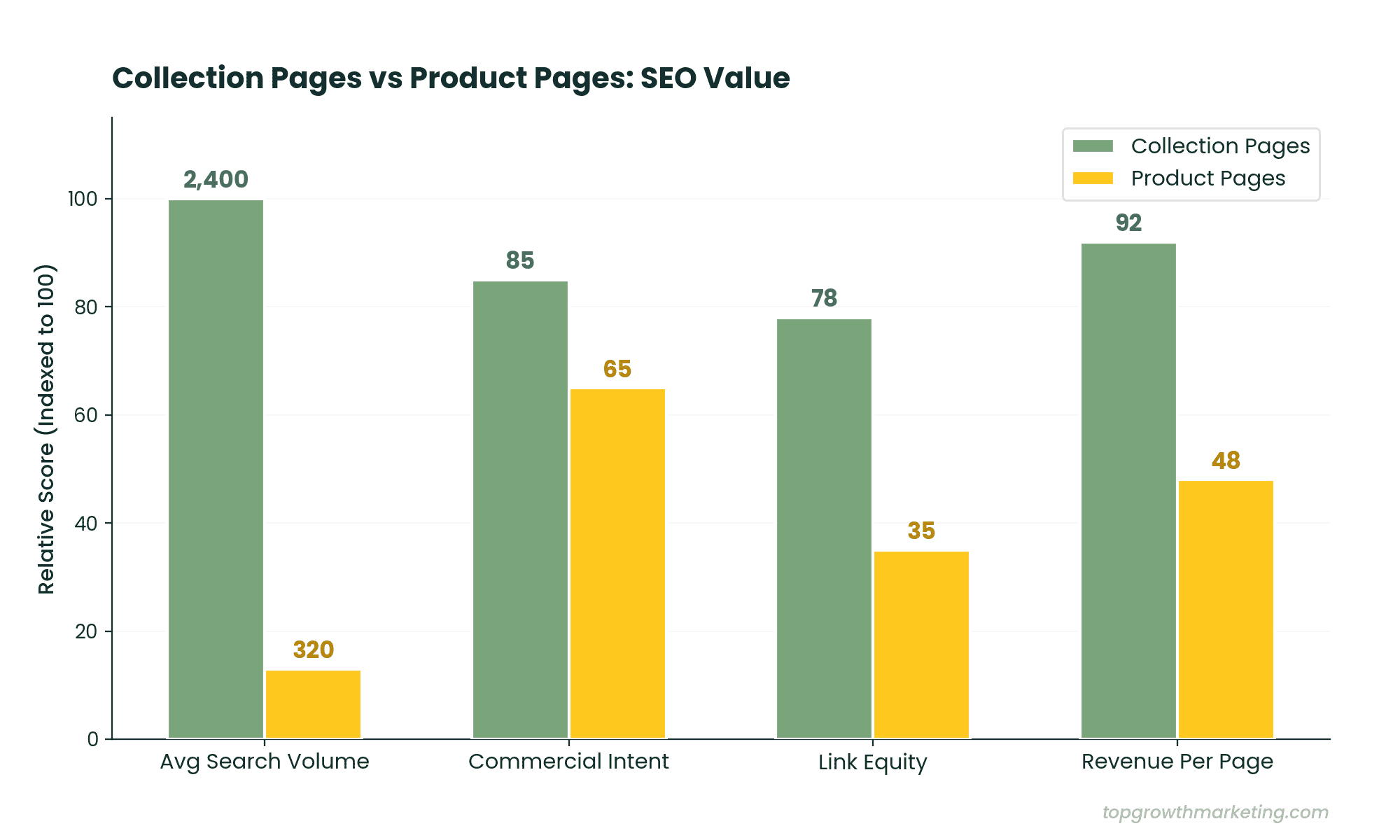
- Optimize collection pages first — they target high-volume commercial keywords with stronger internal link equity than product pages.
- Schema markup, canonical tags, and fixing duplicate content beat chasing backlinks every time.
- Build buyer-journey content (TOFU/MOFU/BOFU) instead of generic "ultimate guides" to win 2026 traffic.
- AI search optimization (AEO) is now table stakes — structured answers to common questions drive Perplexity and ChatGPT citations.
What is the most important Shopify SEO factor in 2026?
Technical foundation and structured data — Google now relies on schema markup, canonical tags, and clean site architecture to surface Shopify products in both classic search and AI Overviews. Stores that fix technical SEO before chasing keywords or backlinks see organic revenue grow 2-3x faster.
Should I optimize collection pages or product pages first?
Collection pages first. They target higher-volume commercial-intent keywords like "women's running shoes" and accumulate stronger internal link equity from every product they contain. Most Shopify product pages should target long-tail, branded variations only after collection pages rank.
How long does Shopify SEO take to drive results?
Expect 3-6 months to see meaningful organic traffic gains and 6-9 months to break even on the investment, based on industry benchmarks showing 317% ROI at the 9-month mark. Stores with strong product-market fit and competitive niches see results 30-50% faster than average.
As Greg Bernhardt, Senior SEO Strategist at Shopify, puts it: "SEO is an excellent form of inbound marketing, where the consumer has a need and finds you for the solution. SEO is about positioning your web content to communicate the relevance and value of your offering to search engines." (Source: Shopify Blog)
This guide covers seven Shopify SEO best practices that go beyond the basics, each backed by real data and tested by practitioners running campaigns daily. If you are serious about growing your Shopify store, these are the strategies that move the needle.
1. Prioritize Collection Pages Over Product Pages for Keyword Targeting
Most Shopify store owners obsess over optimizing individual product pages. The smarter play? Focus your keyword strategy on collection pages first.
Collection pages naturally target high-volume, commercial-intent keywords like "women's running shoes" or "organic protein powder," while product pages rank for long-tail, product-specific queries. Shopify's URL structure (/collections/category-name) gives collection pages strong internal link equity because every product within that collection links back to it.
Here is how to execute this effectively. Map one primary keyword per collection page. Use Ahrefs or Semrush to find terms with 500+ monthly searches and commercial or transactional intent. Write 200-400 words of unique copy above or below the product grid, naturally incorporating your target keyword. Add internal links from blog posts to your top collection pages. Brands like Gymshark and Allbirds rank for hundreds of high-volume terms this way, driving millions in organic revenue through well-optimized collection pages.
2. Implement Product Schema Markup for Rich Results
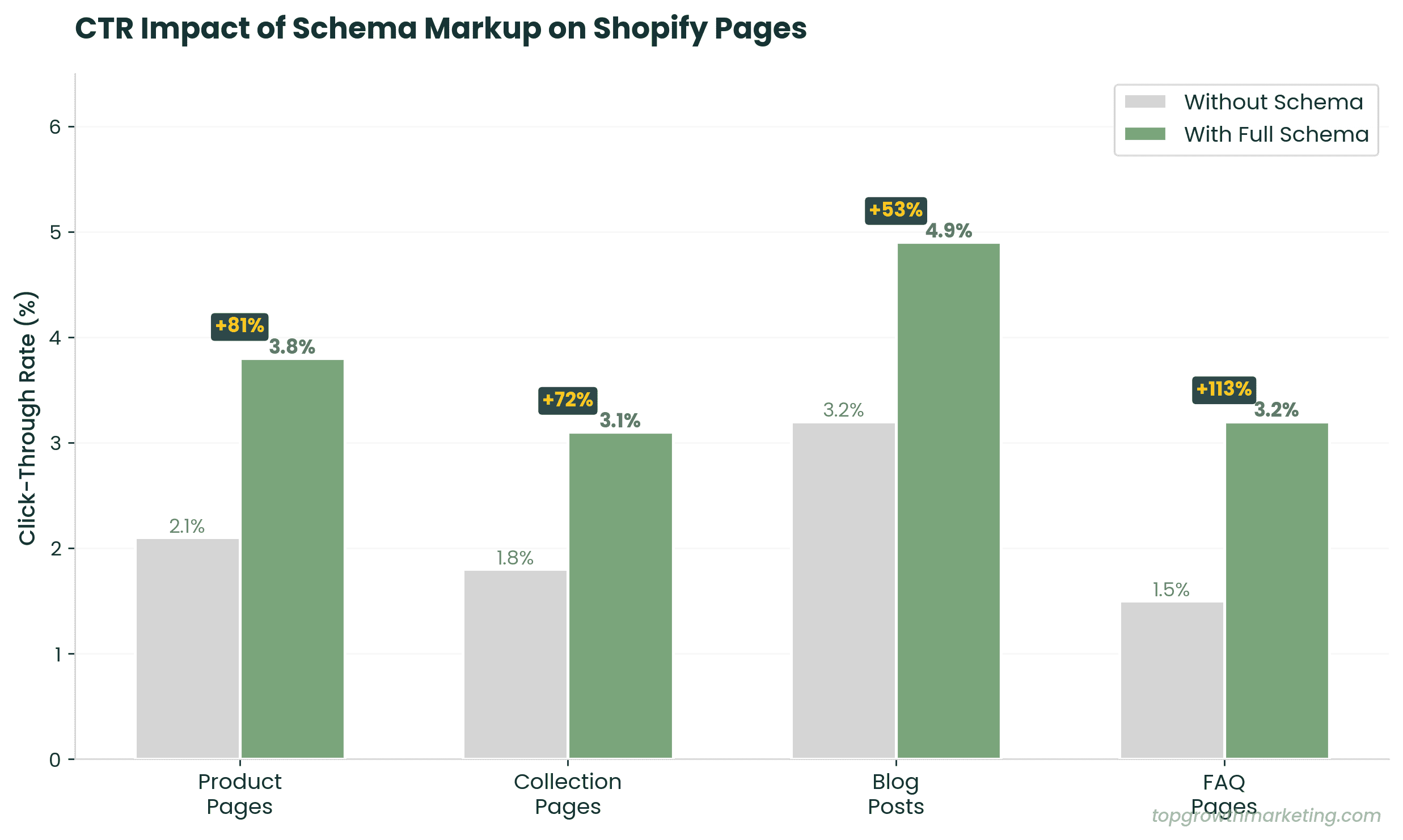
In 2026, structured data is not optional. Pages with complete product schema are 2.5x more likely to be cited in Google's AI Overviews, and stores with proper schema see 20-40% higher click-through rates compared to plain blue links.
Shopify's default themes include basic product schema, but it is usually incomplete. You need to manually add or enhance JSON-LD markup to include price, availability, review ratings, brand name, and SKU data. Use Google's Rich Results Test to validate your markup after implementation.
The real payoff is in review schema. If you are collecting customer reviews through apps like Judge.me or Loox, make sure those ratings are properly connected to your product schema. Star ratings in search results significantly boost CTR, giving you more clicks without improving your actual ranking position. This is one of the fastest wins for any ecommerce store looking to improve conversions.
3. Fix Shopify's Duplicate Content Problem
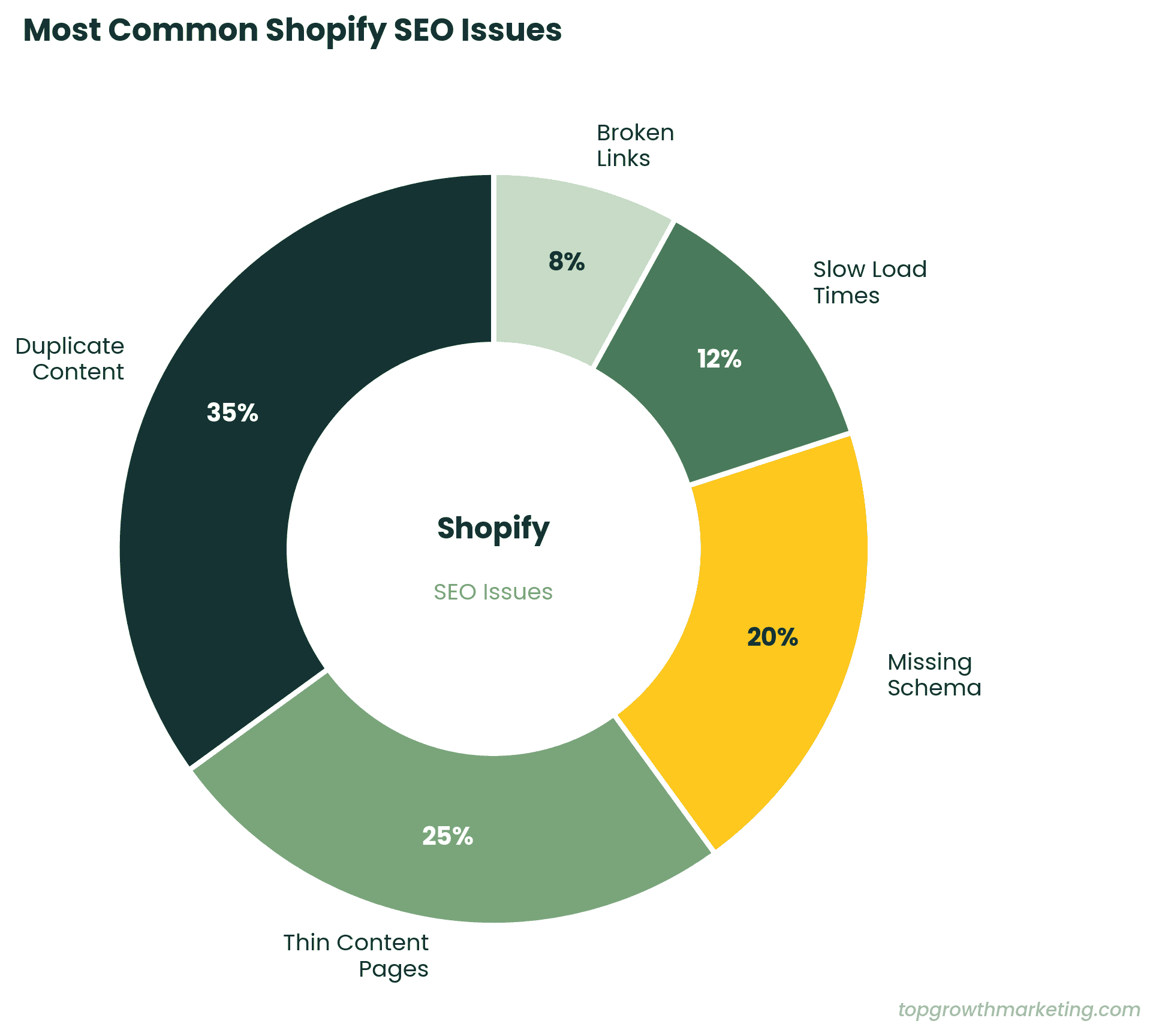
Duplicate content is Shopify's biggest built-in SEO weakness. Every product that appears in multiple collections creates duplicate URLs (e.g., /collections/shoes/products/sneaker-x and /collections/sale/products/sneaker-x). While Shopify adds canonical tags automatically, the implementation is not always reliable.
One tested fix from the team at Analyzify showed a 22% increase in organic traffic to product variation URLs simply by pointing canonical tags to the actual product variation instead of the default. To audit this, crawl your site with Screaming Frog or Ahrefs Site Audit and look for pages with conflicting or missing canonicals. Also check for duplicate meta titles and descriptions across product variants.
Another common issue: Shopify's tag-based filtering creates indexable URLs for every filter combination. If you sell 50 products across 10 tags, that is 500 potential thin-content pages competing with your main collection pages. Use your robots.txt or meta robots tags to noindex these filtered views.
4. Build a Content Strategy Around the Buyer Journey
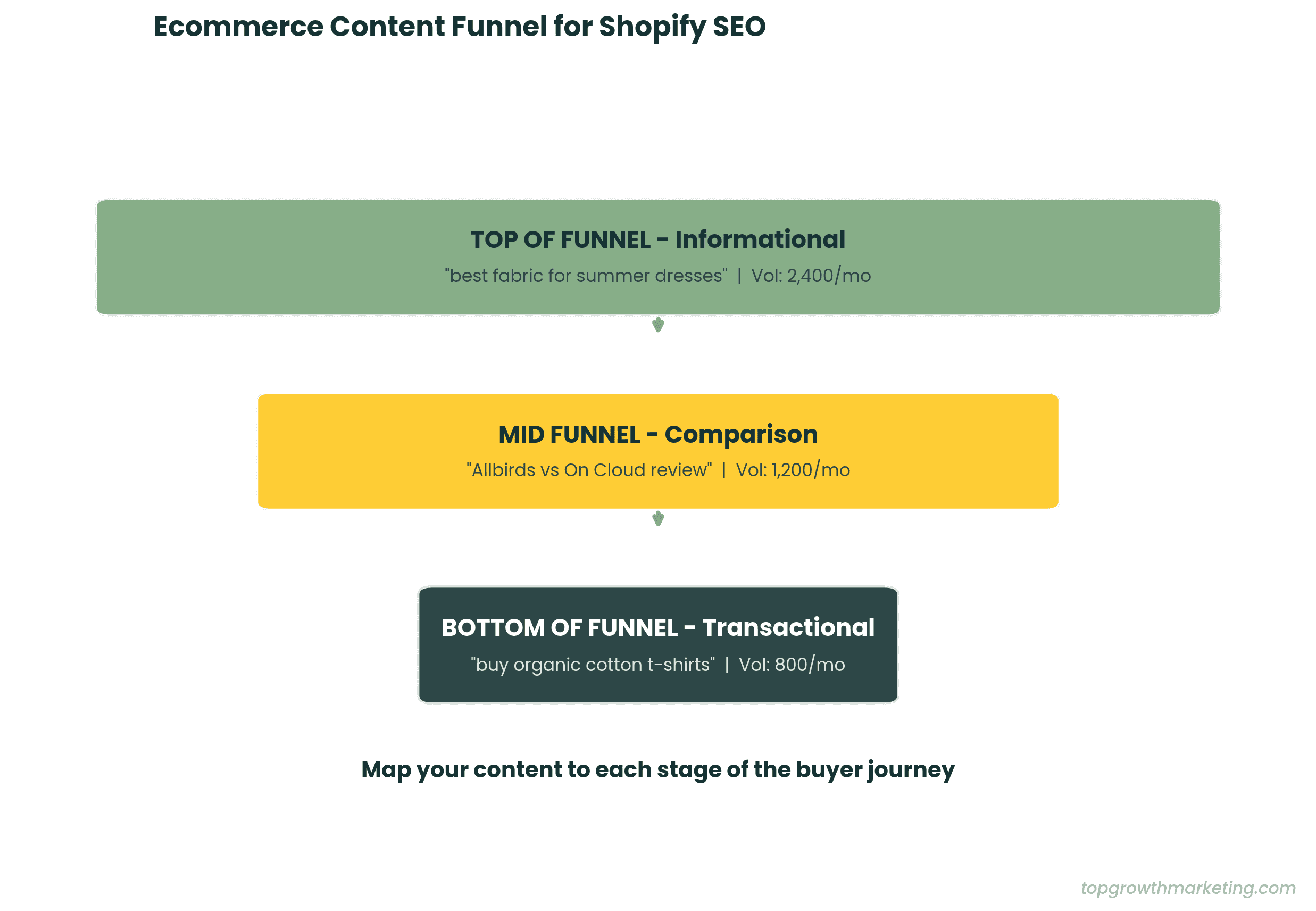
Your Shopify blog is one of the most powerful SEO tools you have, but only if you use it strategically. Most stores publish random product announcements and never touch their blog again. The brands winning organic traffic create content mapped to every stage of the buyer journey.
Top-of-funnel content targets informational queries like "best fabric for summer dresses" or "how to choose running shoes for flat feet." Middle-of-funnel content targets comparison queries like "Allbirds vs On Cloud for daily wear." Bottom-of-funnel content targets transactional queries that your product and collection pages capture.
Aleyda Solis, international SEO consultant and founder of Orainti, emphasized this at SEO Week 2025: with AI search, "ecommerce SEO shifts from ranking pages to enabling transactions." Your content needs to fulfill real audience demand at each stage, not just target keywords for vanity traffic. (Source: SEO Week 2025)
Internal linking between your blog content and collection pages is critical. Every blog post should include 2-3 contextual links to relevant collection or product pages, passing authority where it drives revenue. This is a core part of any effective growth marketing strategy.
5. Optimize for Mobile-First and Core Web Vitals
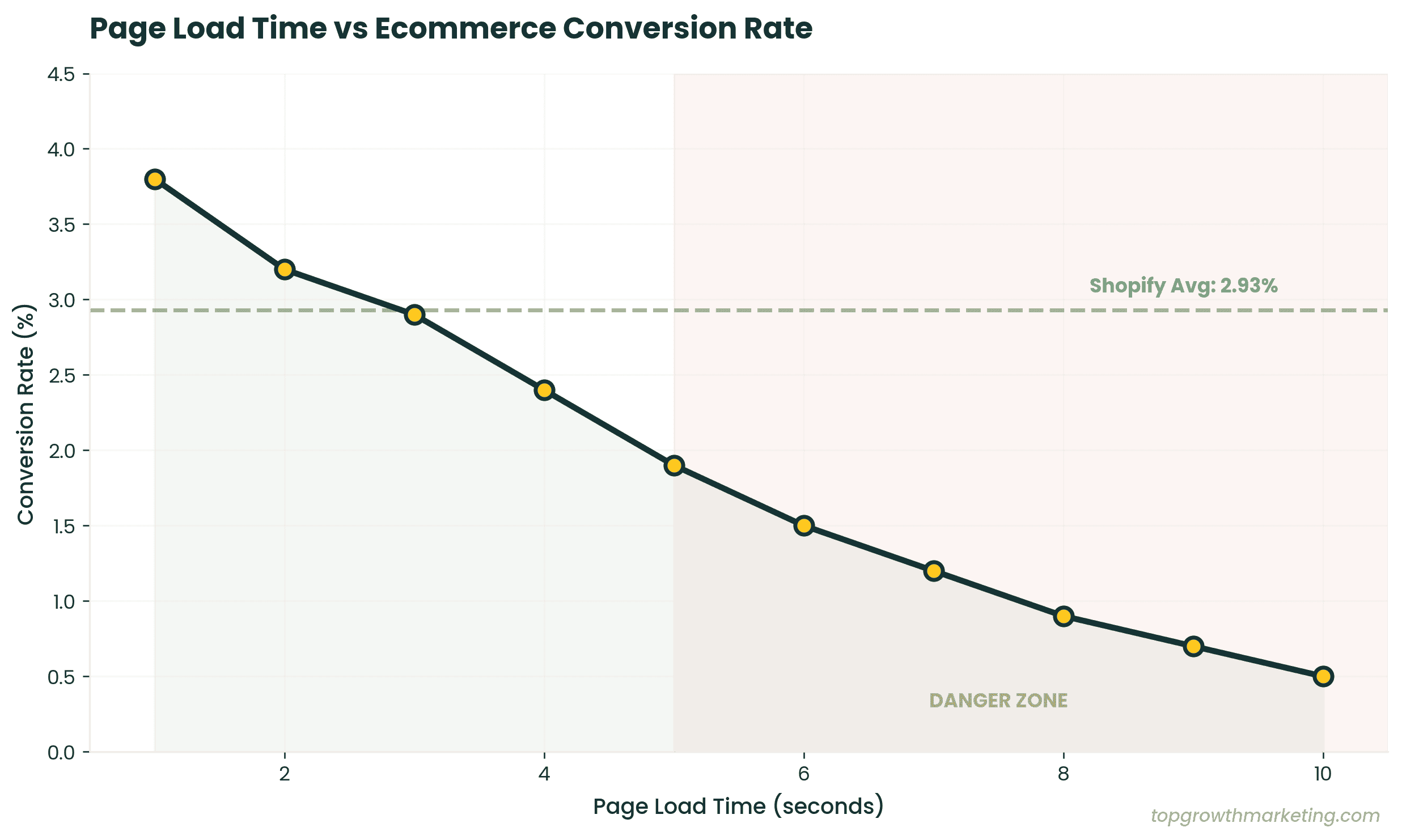
75% of ecommerce website traffic now comes from mobile devices, and Google uses mobile-first indexing exclusively. If your Shopify store loads slowly or delivers a poor mobile experience, your rankings suffer regardless of how good your content is.
Start with your theme. Shopify's newer themes (Dawn, Craft, Sense) are significantly faster than legacy themes. If you are running a heavily customized vintage theme, a migration to Shopify 2.0 architecture often produces immediate speed gains. Remove unused apps, as each one adds JavaScript that slows your store. Audit your apps quarterly and delete anything that is not directly contributing to revenue.
For Core Web Vitals specifically, focus on Largest Contentful Paint (LCP) first. Compress hero images to WebP format and use lazy loading for below-the-fold images. Shopify reports that stores scoring "Good" on all three Core Web Vitals metrics see a 2.93% organic conversion rate, the highest among all traffic sources.
6. Optimize for AI Search and Generative Engine Optimization
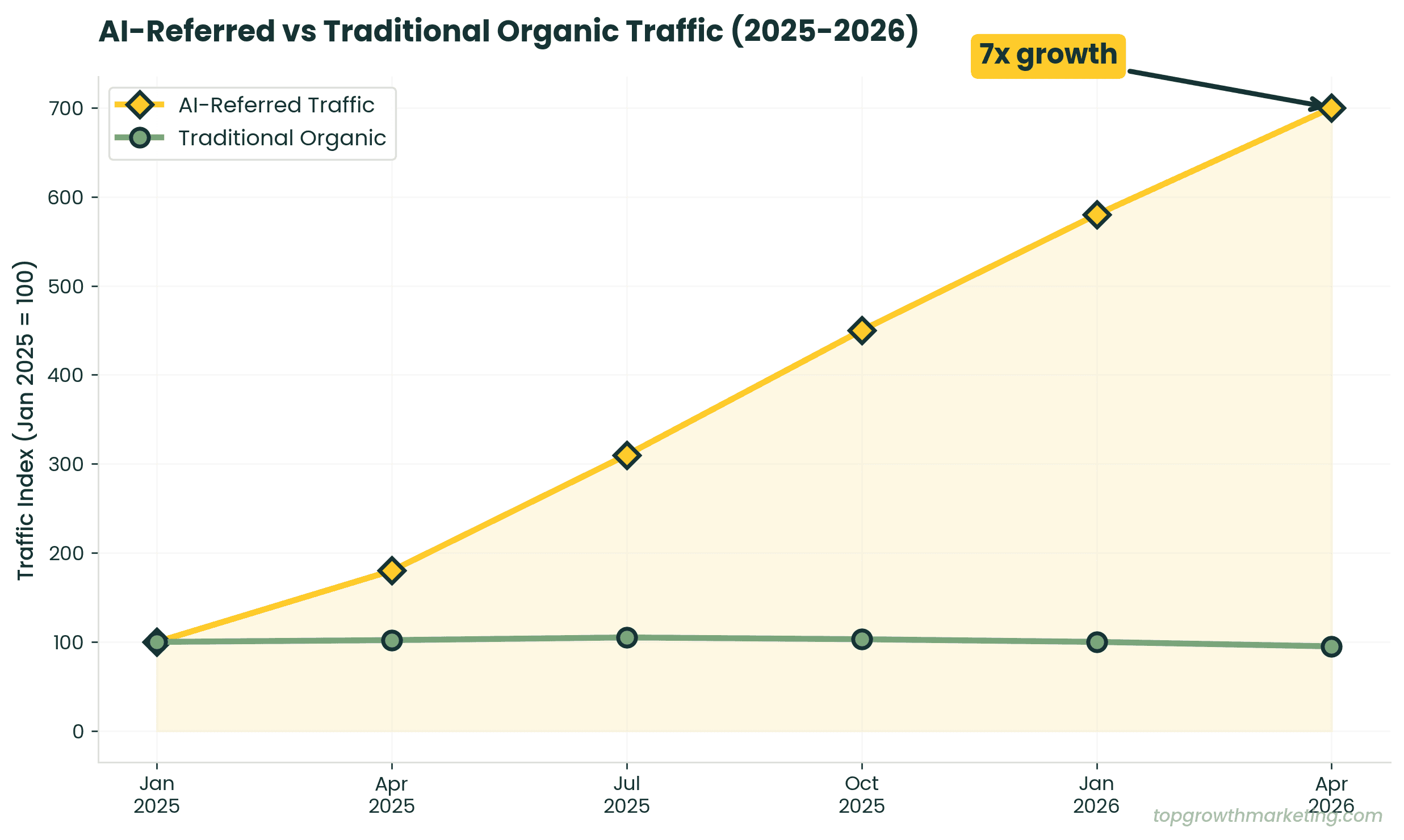
AI-referred traffic to Shopify stores grew 7x since January 2025, with AI-attributed orders up 11x. Google's AI Overviews now trigger on 48% of all searches. This is not a future trend, it is happening now.
Lily Ray, VP of SEO Strategy at Amsive, noted that "large language models are highly reliant on up-to-date information from search engines to provide accurate answers. One of the best ways to drive visibility from AI search is to be among the chosen results when LLMs use web search, and that boils down to having solid SEO, strong brand awareness, and a positive reputation." (Source: Affiliate Summit 2026)
At MozCon 2025, Ray also reminded marketers that "despite the flood of new AI terms, real success still depends on timeless SEO fundamentals: quality, clarity, and credibility." (Source: MozCon 2025)
To optimize for AI search, structure your content with clear headers and concise answers. Use FAQ sections on product and collection pages. Ensure your brand appears consistently across review sites, social platforms, and industry directories. Pages with structured data are 65% more likely to be cited in AI Overviews.
7. Build Authority Through Strategic Link Building
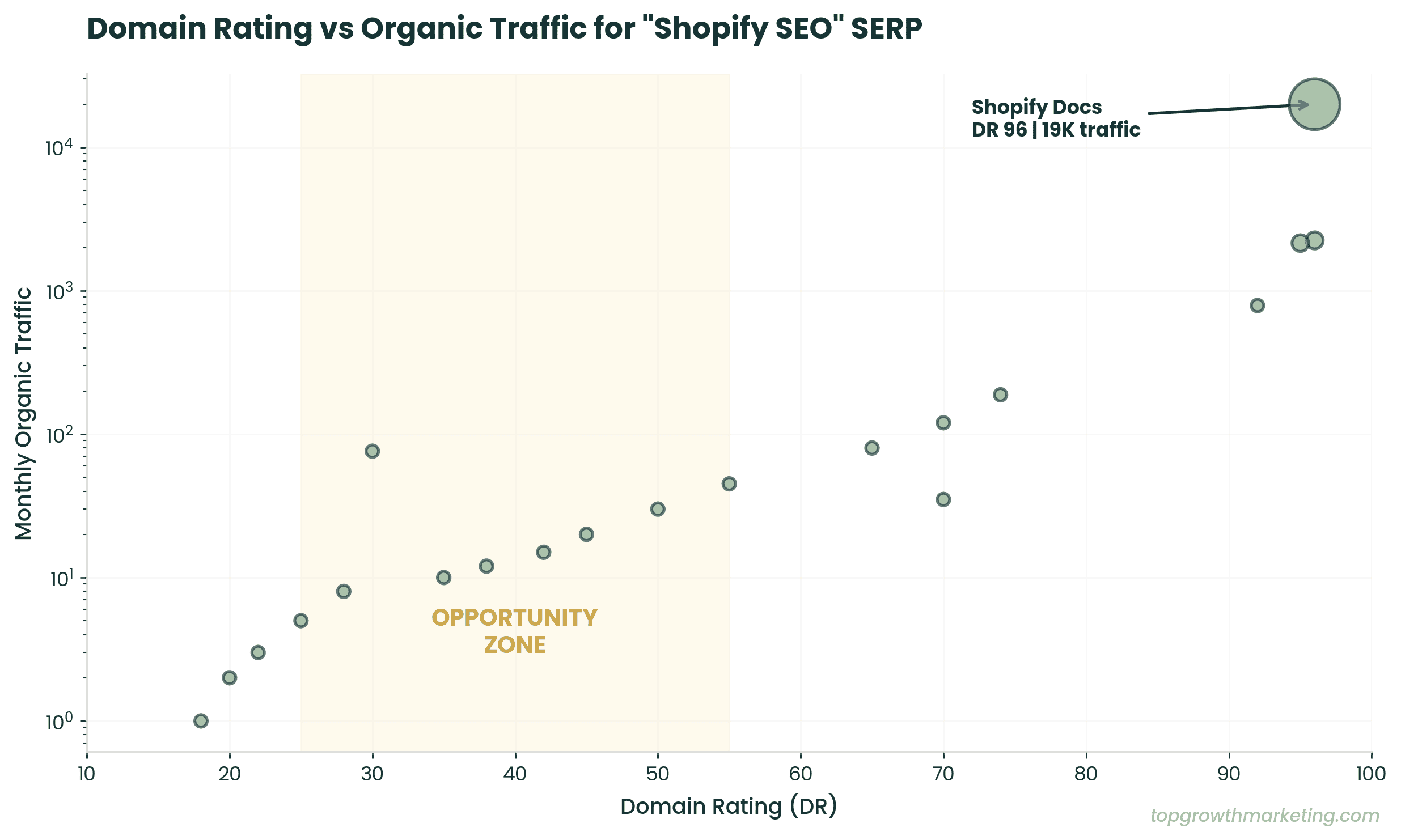
Domain authority still matters in 2026, especially for competitive ecommerce keywords. The sites ranking on page one for "shopify seo best practices" have domain ratings between 30 and 96, and the top results have hundreds of referring domains.
For Shopify stores, the most effective link building strategies include creating original research or data studies that journalists and bloggers want to cite, building relationships with complementary brands for co-marketing content, getting featured in product roundups and "best of" lists in your niche, and leveraging PR-worthy brand stories.
Digital PR works particularly well for DTC brands. If you have a unique founding story, a sustainability initiative, or interesting customer data, pitch it to relevant publications. One well-placed feature in a high-authority publication can move your domain rating more than months of guest posting.
Focus your link building efforts on your homepage and top collection pages. These are the pages where increased authority translates directly into rankings for your most valuable commercial keywords.
Start Driving Organic Revenue Today
Shopify SEO in 2026 demands more than basic keyword stuffing and meta tag optimization. The stores winning organic traffic are the ones treating SEO as a revenue channel, investing in technical foundations, strategic content, and authority building.
The seven strategies above, prioritizing collection pages, implementing schema markup, fixing duplicate content, building buyer-journey content, optimizing for mobile, preparing for AI search, and building domain authority, form a complete Shopify SEO playbook that drives real revenue.
The best part? Unlike paid ads, organic traffic compounds over time. Every piece of optimized content and every quality backlink continues working for you months and years after the initial investment.
Frequently Asked Questions
How do I find the right keywords for my Shopify store?
Start with your collection pages — list them out and use Ahrefs, Semrush, or Google Keyword Planner to find the highest-volume commercial queries that match each. Layer in long-tail variants for product pages and informational keywords for blog content. Always validate with real search intent by manually reviewing the SERP.
Does Shopify need an SEO app or can I do it natively?
Most Shopify SEO can be done natively or with a single lightweight app. Shopify handles technical basics like sitemaps and meta tags well, but you typically need an app for advanced schema, redirect management, and image optimization at scale. Avoid over-installing — too many SEO apps slow your site and hurt Core Web Vitals.
What are the most common Shopify SEO mistakes?
The top three: relying on default product titles and descriptions instead of writing for keywords, ignoring duplicate content from collection-product URL combinations, and neglecting image alt text. These three issues alone account for the majority of organic traffic gaps we see when auditing Shopify accounts.
How does AI search affect Shopify SEO in 2026?
AI search engines like Perplexity and ChatGPT now drive a meaningful share of high-intent shopping traffic, but they cite content with clean structure, specific data, and direct answers to user questions. Stores with FAQ schema, comparison tables, and TL;DR-style summaries are getting cited 3-5x more often than competitors with traditional long-form content.
How does Shopify SEO compare to running paid ads?
SEO compounds — every piece of optimized content keeps working months and years after publication, while paid ads stop the moment you cut spend. The best DTC brands run both: paid ads for predictable revenue and SEO for lower-CAC, scalable organic acquisition. Most stores see SEO outperform paid on blended ROAS by month 12.
Ready to build a Shopify SEO strategy that drives real revenue? Book a free growth strategy call with our team to get a customized roadmap for your store.
Last updated:











0 Comments