
TL;DR
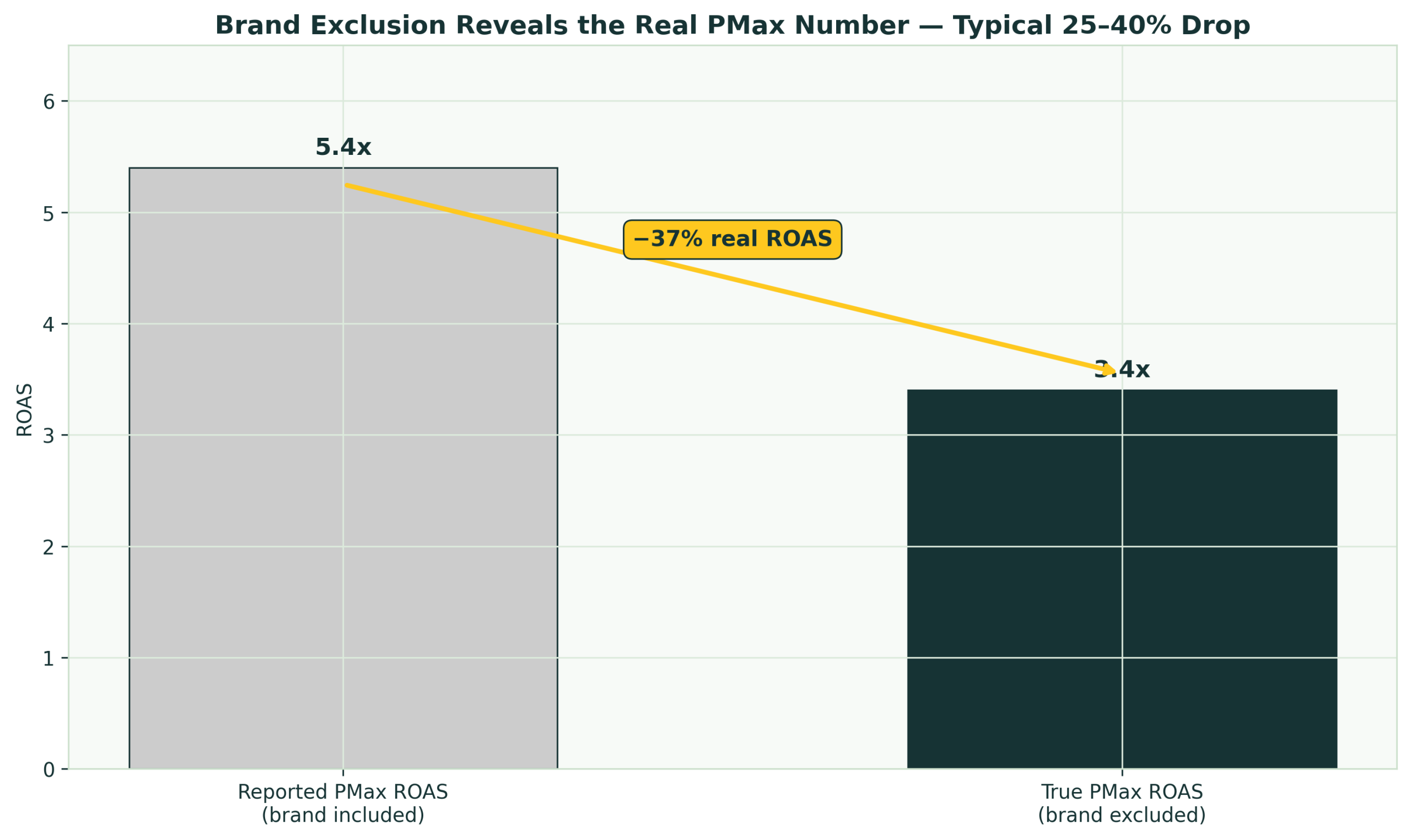
- PMax inflates ROAS with branded conversions; always exclude your brand to see true incrementality.
- Conversion tracking quality is the #1 driver of PMax performance — fix this before anything else.
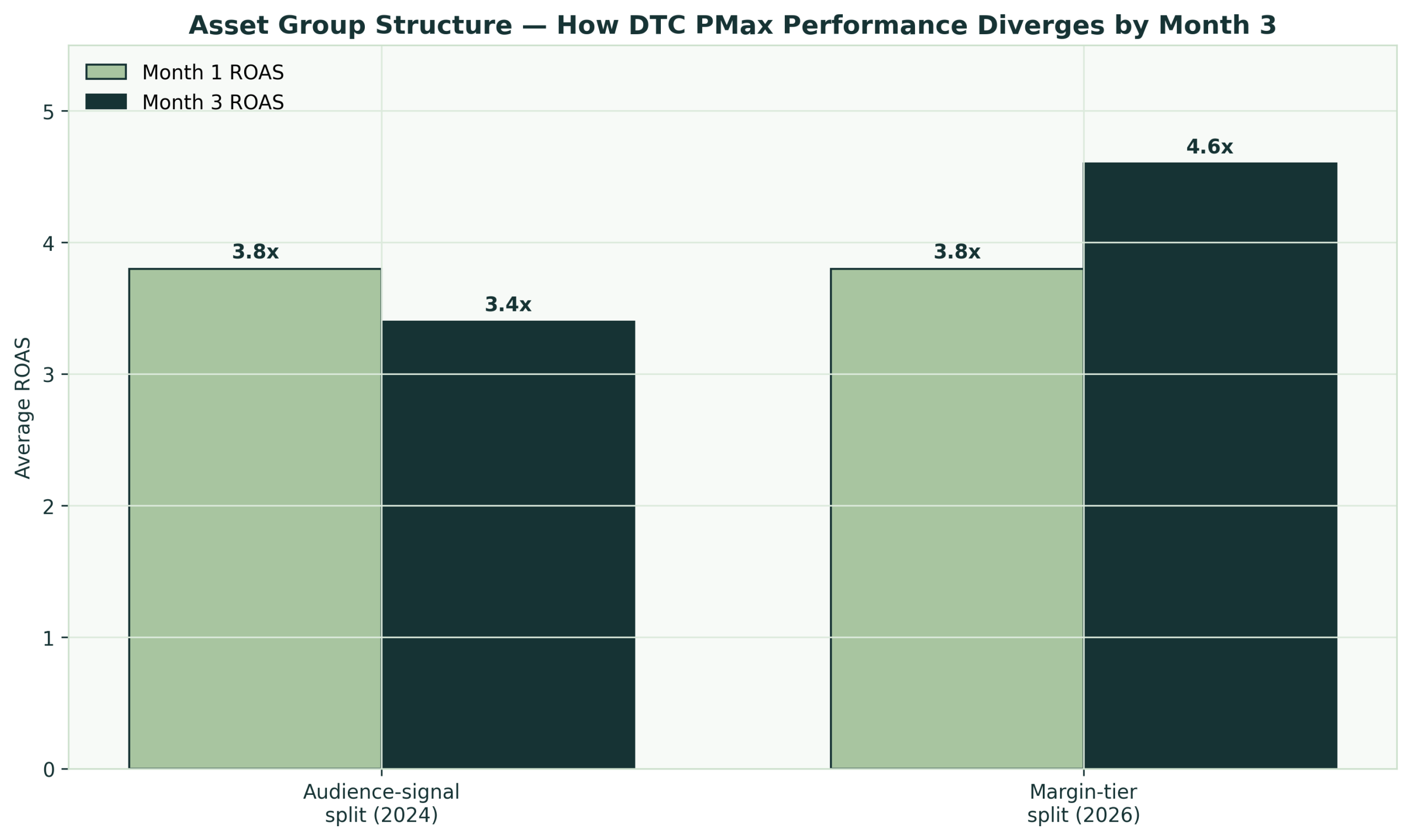
- One asset group per audience signal is dead in 2026; performance converges to the average.
- Use the new account-level negative keyword list (1,000 keywords) and placement exclusions for brand safety at scale.
- Pair PMax with a tight Branded Search campaign — never let PMax cannibalize brand keywords.
Why is my Performance Max ROAS overstated?
PMax counts branded conversions that would have happened anyway via Branded Search, inflating reported ROAS by 30-60% in most DTC accounts. Always exclude your brand keywords using account-level negative lists, then compare PMax ROAS against your true incremental cost-per-acquisition to see real performance.
How many asset groups should a Performance Max campaign have?
Run one asset group per distinct theme or audience signal — typically 1-3 per campaign in 2026. Splitting into 5+ groups dilutes signal strength and forces performance to converge to the average. Group by theme (best-sellers, new arrivals, hero collections), not by keyword segments.
Should I use Performance Max alongside Branded Search?
Yes — always run a tight Branded Search campaign in parallel and use account-level negative keywords in PMax to prevent it from cannibalizing branded traffic. This protects your true incremental ROAS and ensures PMax is driving net-new revenue, not double-counting brand searches.
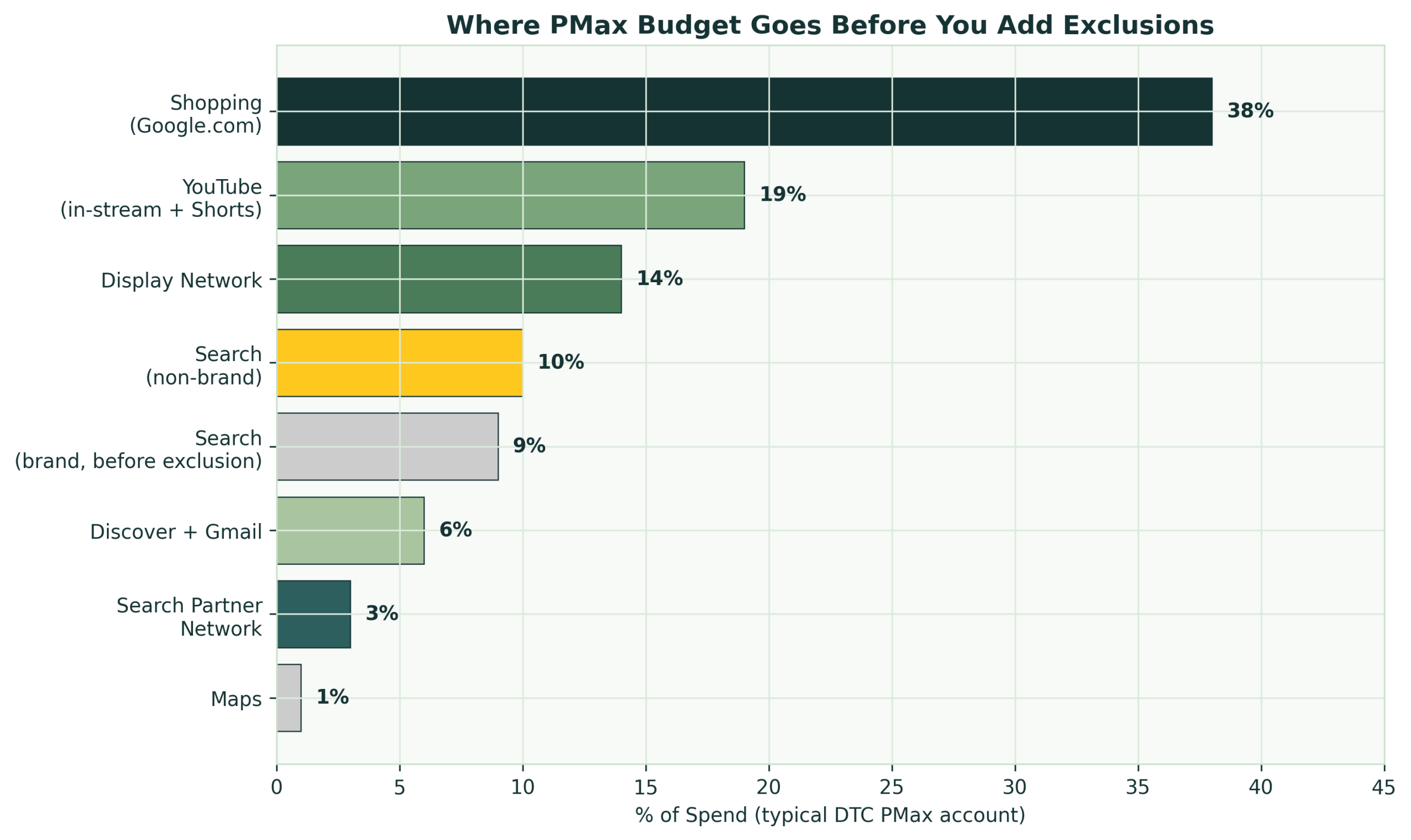
Performance Max has become the default growth lever for DTC brands on Google — and also the easiest way to quietly waste 30% of your paid search budget. Five years in, PMax averages roughly 4.1x ROAS at a 2.4% conversion rate across ecommerce accounts, but 64% of DTC brands say they are struggling to optimize it, either burning spend on branded traffic that would have converted anyway or letting the algorithm chase the wrong audience.
The good news: 2026 is the first year where Google has handed advertisers real levers — account-level placement exclusions, a 10,000-keyword negative list, brand exclusions, and Search Partner placement transparency. Used together, these turn PMax from a black box into a controllable channel. This playbook is what we run on Performance Max accounts at Top Growth Marketing's Google Ads Agency for DTC brands spending $25K–$500K/month, with the structural changes, asset standards, and 2026 features that actually move ROAS.
Why most DTC Performance Max campaigns underperform
Performance Max is an automated, AI-driven campaign type that runs ads across Search, Shopping, YouTube, Display, Discover, Gmail and Maps from a single budget. The trade-off is control: you give Google your goals, assets and audience signals, and the algorithm decides where to spend.
The two failure modes we see in audits are predictable. The first is branded inflation — PMax claims credit for conversions from people searching your brand name, who would have bought regardless. As Caterina Mariani, eCommerce Growth Specialist at PPC Freelance, puts it: "Don't be misled by PMax's strong performance numbers. To get the true picture, always cross-check PMax data against your overall business metrics: total revenue, profit, customer acquisition cost (CAC), and average order value (AOV)."
The second is conversion signal pollution — feeding PMax low-quality conversion events (newsletter signups, view content) so the algorithm optimizes for the wrong outcomes. PMax is a pattern-matching machine; if your patterns are noisy, your spend goes sideways.
"PMax results can appear inflated due to branded search conversions that would have happened anyway. For an honest read, exclude your brand and compare ROAS again." — Hana Kobzova, PPC strategist (LinkedIn, 2025)
The 2026 PMax features that change the math
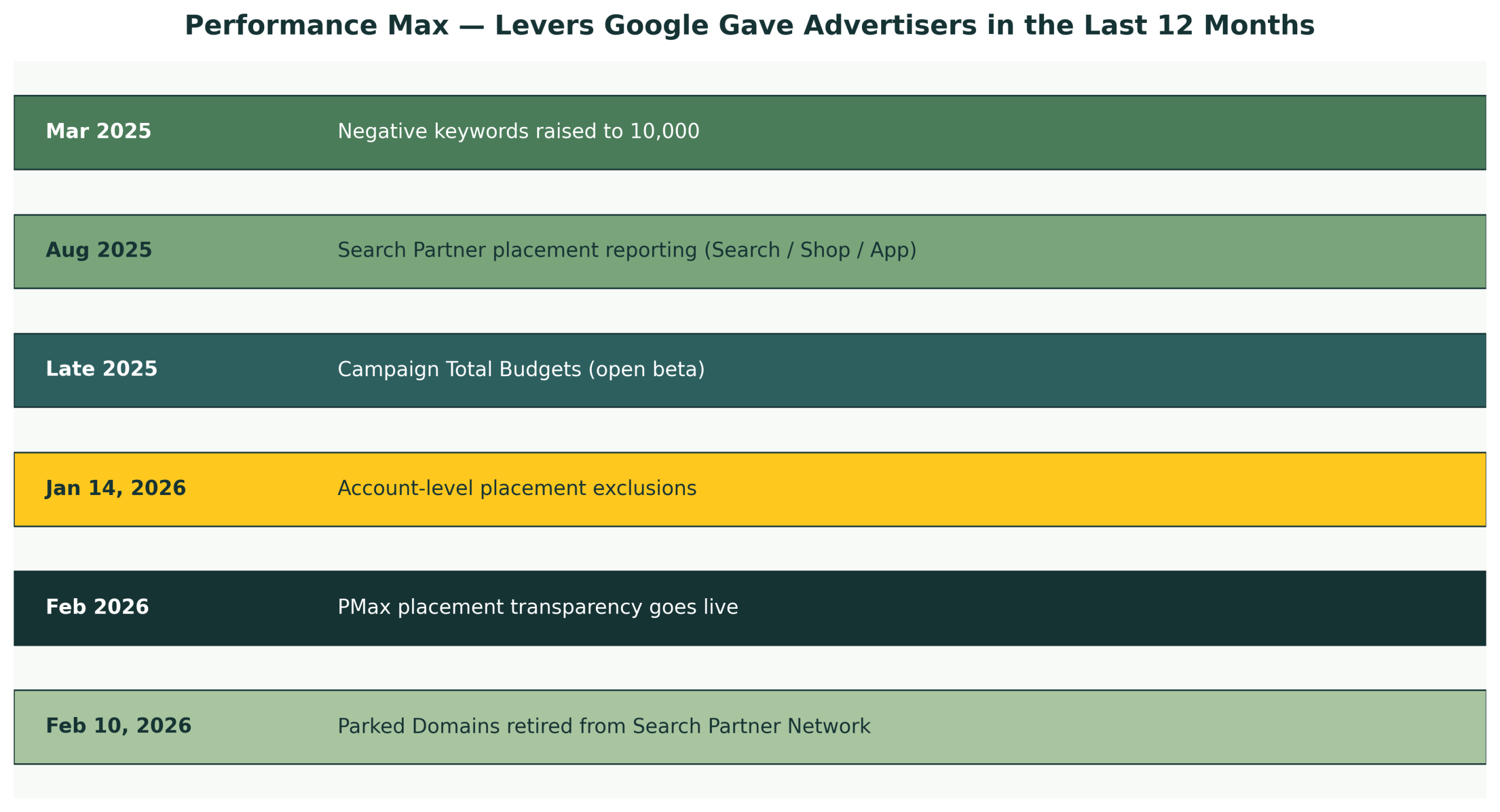
Three features shipped in the last 12 months are worth restructuring around.
Account-level negative keywords (1,000 limit, March 2025) apply across every campaign — Search, Shopping and PMax — and are perfect for irrelevant intent (job searches, "free", competitor brand variations). Pair this with the campaign-level negative keyword limit, which Google raised from 100 to 10,000 in March 2025, and you finally have search-campaign-level control inside PMax.
Account-level placement exclusions (rolled out January 14, 2026) apply to every campaign in the account, including future ones. This is the cleanest way to cut MFA (made-for-advertising) sites, kids' apps, and low-quality Display inventory across PMax and Demand Gen at the same time.
Search Partner Network placement reporting (February 2026) finally exposes which Search Partner domains your PMax ads are appearing on — a transparency demand advertisers had made for years. You can't yet attribute revenue per domain, but you can see impression counts and use that data to build exclusion lists. Parked Domains were retired from the network on February 10, 2026, removing one of the most common sources of wasted spend.
Step 1: fix conversion tracking before you touch anything else
Every audit we run starts here, because a misconfigured PMax with clean tracking outperforms a perfectly structured PMax with broken tracking. The order matters.
- One primary conversion, value-based — almost always Purchase with revenue passed through. Do not stack newsletter signups, add-to-cart, or "view checkout" as primaries.
- Enhanced Conversions for web, sending hashed first-party data (email, name, address) to recover signal lost to iOS privacy and ad blockers.
- GA4 + Google Ads conversion linker confirmed firing once per transaction, no double-count.
- Server-side tagging via GTM if you're a Shopify Plus brand running headless — client-side gtag misses 15–25% of events on mobile Safari.
- A 30-day clean-up window — if you're switching primary conversions, give the algorithm two weeks to relearn before you judge results.
If conversion volume is below ~30 conversions per campaign per month, PMax will struggle. Below that threshold, run Standard Shopping and a tightly-themed Search campaign first, then layer PMax once data accumulates.
Step 2: rethink the asset group structure
The single biggest 2026 mindset shift is that asset-group-per-audience-signal no longer works. Google's own data and the Smarter Ecommerce State of PMax 2025 report (4,000+ campaigns) show duplicate asset groups converge to the same average performance after 4–6 weeks. The algorithm reallocates budget regardless of how you sliced the audience.
What does work in 2026 is structuring asset groups by margin tier or product theme, then letting Google decide who to show them to. Three patterns we use:
- High-margin hero SKUs in their own asset group with a tight ROAS target (e.g. 5.0).
- Mid-margin catalog as the volume driver with a moderate target (e.g. 3.0–3.5).
- Clearance / liquidation in a separate asset group with a tROAS that protects unit economics (e.g. 2.0).
This lets you set budgets by contribution margin rather than by demographic guesswork, which is what the new "Campaign Orchestration" approach — using dynamic segments to shift products between budget pools based on stock pressure, margin and competition — is built around.
Step 3: weaponize brand exclusions
The single fastest ROAS win we apply to inherited PMax accounts is brand exclusion. PMax will, by default, serve ads to people searching your exact brand name, recapturing conversions your free organic clicks would have earned. The fix takes ten minutes:
- In Google Ads → Tools → Shared Library → Brand lists, create a list with your brand, URL, and common misspellings.
- Apply the brand list to your PMax campaign under campaign settings → brand exclusions.
- Run a dedicated Branded Search campaign alongside it — exact match on your brand, manual CPC, low budget — to capture brand demand cheaply with full visibility.
This setup gives you an honest read on whether PMax is acquiring new customers or just claiming credit for warm traffic. For most DTC brands we audit, brand-excluded ROAS drops 25–40% — that's the real number.
Step 4: feed and creative — the parts Google can't fake
When you remove the targeting levers, the remaining variables are your shopping feed and your creative assets. Both are now the highest-leverage point in any PMax account.
Feed:
- Title structure: Brand + Product Type + Key Attribute + Variant (e.g. "Allbirds Tree Runners Lightweight Mesh Sneakers — Men's, Pacific Blue, US 10").
- 3+ images per SKU, including lifestyle, on-white and detail shots.
- GTIN, MPN and brand fields populated — products with full identifiers get prioritized in Shopping inventory.
- Custom labels flagging margin tier, stock level and seasonality so you can segment in Shopping or PMax.
Creative assets:
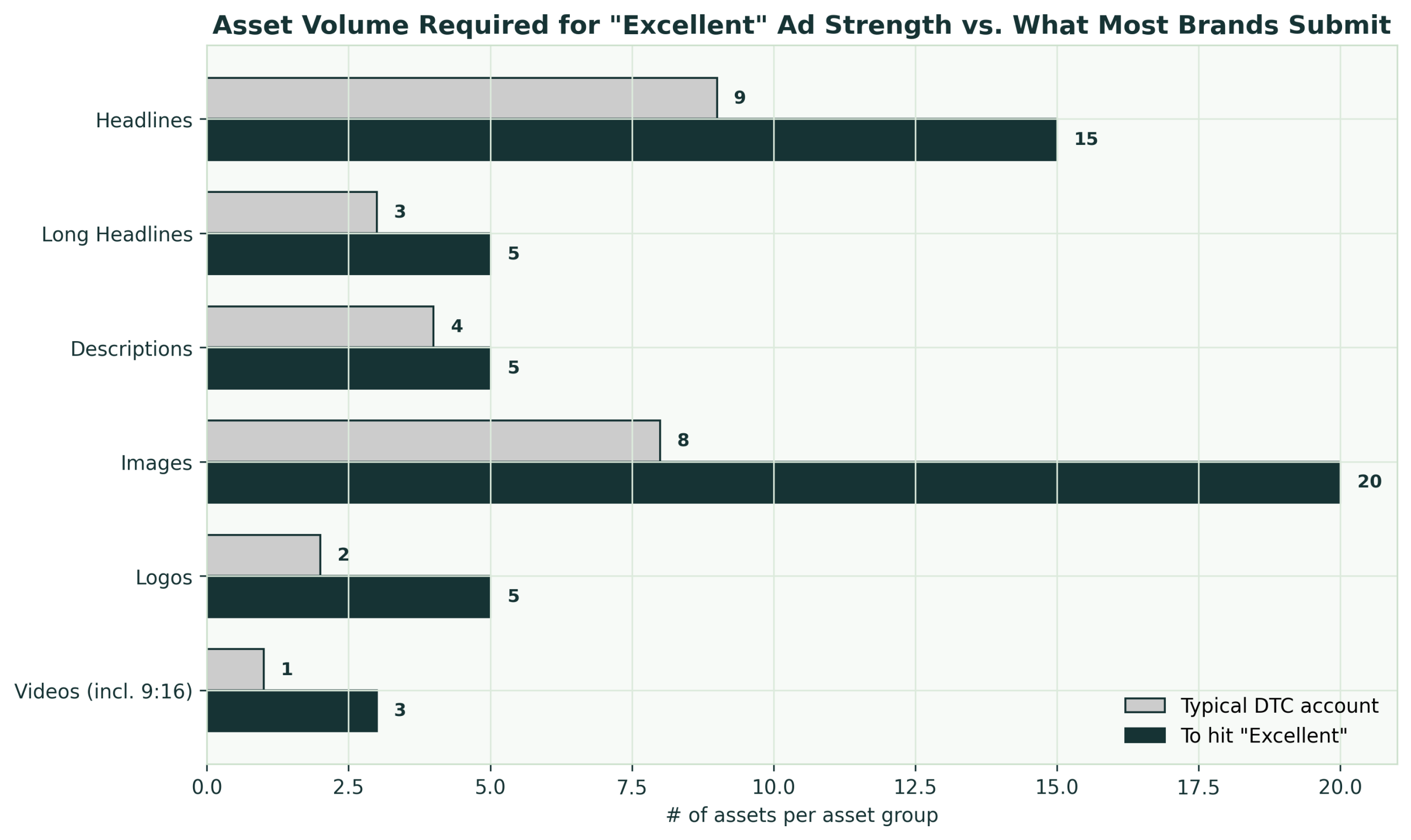
- 15+ headlines, 5 descriptions, 20+ images, 5+ logos, 3+ videos per asset group to hit "Excellent" ad strength.
- Vertical 9:16 video for Shorts and YouTube placements — this is the #1 placement most brands neglect.
- At least one professionally produced video — Google's auto-generated videos from images underperform real production by a meaningful margin.
- Refresh creative every 4–6 weeks to fight fatigue — top brands rotate hooks even when ROAS still looks healthy.
Step 5: read the new placement reports and act on them
With Search Partner placement transparency live, your weekly PMax routine should now include:
- Pull the "Where ads showed" report filtered to PMax. Sort by impressions descending.
- Add anything irrelevant to your account-level placement exclusion list — kids' apps, MFA news sites, parked domain leftovers, irrelevant verticals.
- Cross-reference with the Search Partner placement segment for any domains driving impressions but no conversions.
- Review the asset-level performance report quarterly; cut or replace any asset rated "Low" by Google.
This single workflow — placement exclusions + asset rotation — recovers, in our audits, an average of 12–18% of wasted spend within 30 days.
Step 6: budget rules and total budget cadence
Performance Max responds to budget changes more violently than Search. The algorithm enters a new learning phase any time you change budget by more than ~20%, tROAS by more than 15%, or asset volume by a meaningful amount.
- Increase budgets in 15–20% steps, no more than once a week, after at least 7 days of stable performance.
- Use the new Campaign Total Budgets feature (open beta on Search, Shopping and PMax as of late 2025) to spread spend evenly across multi-week promotional windows.
- tROAS: start at the realistic break-even for your contribution margin, not aspirational. Move it up 10% at a time only after 14 days at target.
- Pause and restart is rarely the right move — PMax loses learning each time. Adjust within the campaign.
The 30-day wins available in most DTC PMax accounts
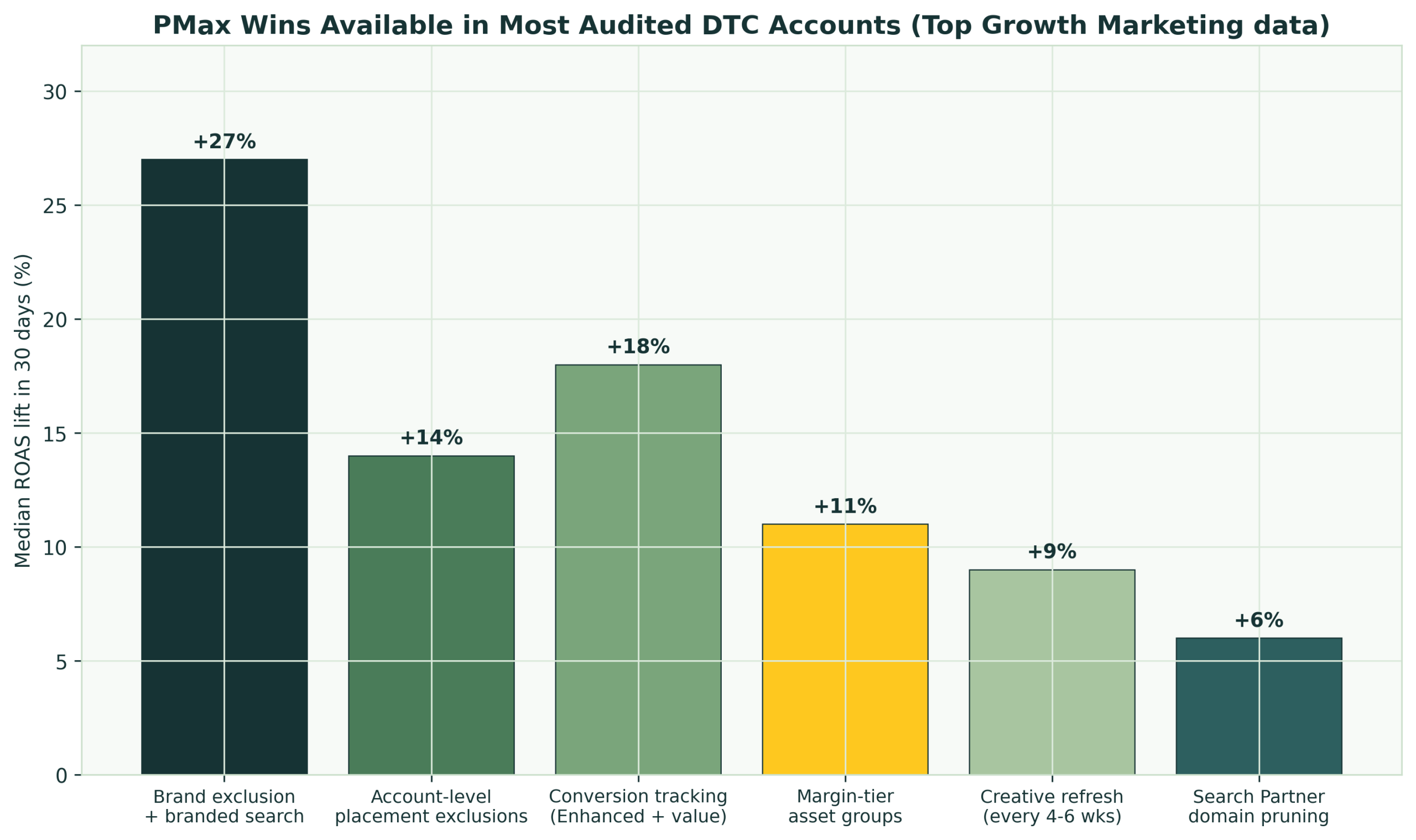
Across the audits we've run on accounts spending $25K–$500K/month, the optimization levers compound — but a few deliver outsized lift in the first month. Brand exclusion is consistently the biggest win, often by a margin. Account-level placement exclusions and conversion tracking fixes are the next two. The chart below shows the median 30-day ROAS lift we see when each lever is applied to a previously-untouched account.
The bottom line
Performance Max in 2026 isn't a plug-and-play growth machine — it's a system that rewards advertisers who fix conversion tracking, structure asset groups by margin, exclude brand traffic, and use the new transparency tools to actively prune waste. Brands that do this consistently see 15–30% higher conversion volume than those running default setups, and — critically — they trust the ROAS number they're reporting to the boardroom.
If you're spending $25K+/month on Google Ads and want a second opinion on your PMax setup, book a Growth Marketing Strategy Call — we'll audit conversion tracking, asset group structure, brand exclusions and feed quality, and walk you through the wins available in your account in the next 30 days.
Frequently Asked Questions
Should I run Performance Max or Standard Shopping in 2026?
Run both if you can. Use Standard Shopping for full control over your highest-margin SKUs and bidding transparency, and use PMax with a brand exclusion list to capture incremental demand across YouTube, Display and Discover. Brands under ~30 conversions per month should start with Standard Shopping until they have enough data for PMax to learn from.
How long does PMax take to optimize?
Plan for a 2–3 week learning phase after launch or major changes. Don't make optimization decisions in the first 14 days. After day 30, you should see a stable trend; if performance is still erratic at day 45, the issue is almost always conversion tracking, asset quality, or feed gaps — not the algorithm.
How many asset groups should I have?
Most DTC brands need 2–4 asset groups segmented by margin tier or product theme, not by audience signal. Duplicate audience-signal asset groups converge to the same performance over time. Keep things clean and let the algorithm allocate.
What's the right tROAS to start with?
Start at your account average of the last 90 days, not your aspirational target. Set tROAS too high at launch and PMax under-spends and never exits learning. Once you've held the average for 14 days, raise the target by 10% at a time.
How do I stop PMax from cannibalizing my brand search?
Build a brand list in Shared Library and apply it as a brand exclusion at the PMax campaign level, then run a dedicated Branded Search campaign to capture brand intent. This is the single highest-leverage change you can make in 2026 and typically reveals 25–40% of "PMax ROAS" was actually branded traffic.
Last updated:
















0 Comments